Chemistry
Zeolite catalyst (faujasite, zeolite Y)
Catalysis · Microporous solids
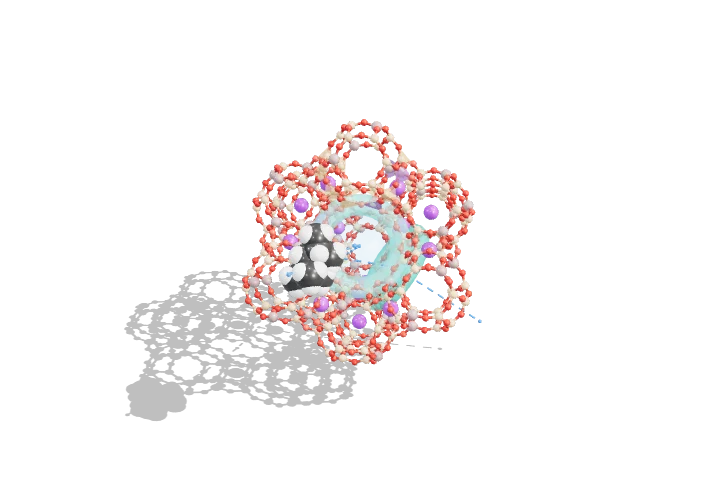 Open the interactive 3D model →
How does a pinch of white powder turn heavy crude oil into the petrol in a car’s tank?
A zeolite is a crystal riddled with tiny cages and windows, each only about a millionth of a millimetre across. Molecules small enough to squeeze through a window reach acidic spots inside, where they are snapped into smaller pieces. Molecules that are too big simply cannot get in.
Zeolites are crystalline aluminosilicates whose corner-sharing SiO₄ and AlO₄ tetrahedra enclose cages and channels of molecular size. Their aluminium sites carry exchangeable cations or acidic protons, so the same crystal is both a strong solid acid and a molecular sieve that decides which molecules can reach the active sites.
Key facts
- Framework type
- FAU (faujasite; synthetic zeolites X and Y), cubic, a ≈ 24.3–24.9 Å
- Unit-cell content
- 192 T atoms and 384 O; 8 sodalite cages, 8 supercages
- 12-ring window
- free aperture ≈ 7.4 Å
- Supercage
- internal diameter ≈ 11–13 Å
- Si/Al ratio
- X: 1–1.5; Y: > 1.5 (≈ 2.5 as made, higher after dealumination)
- Surface area
- ≈ 700–900 m² g⁻¹ (internal pores)
Parts you can explore (11)
- Sodalite cages
- Hexagonal prisms (D6R)
- Aluminium (AlO₄⁻) sites
- SiO₄ tetrahedra
- Supercage
- 12-ring windows
- Brønsted acid site
- Sodium cations
- Reactant molecule
- Cracked products
- Diffusion path
In the 3D model
Rotate and take apart the model, follow a guided tour of what each part does and why it’s needed, change it with a live slider, and test yourself with a short quiz. Free, no sign-up.
Open Zeolite catalyst (faujasite, zeolite Y) in 3D →
OpenArc Models’ models are simplified teaching schematics. Terms · Privacy