Electromagnetism & electronics
Qi wireless charger
Electromagnetism · Inductive power transfer
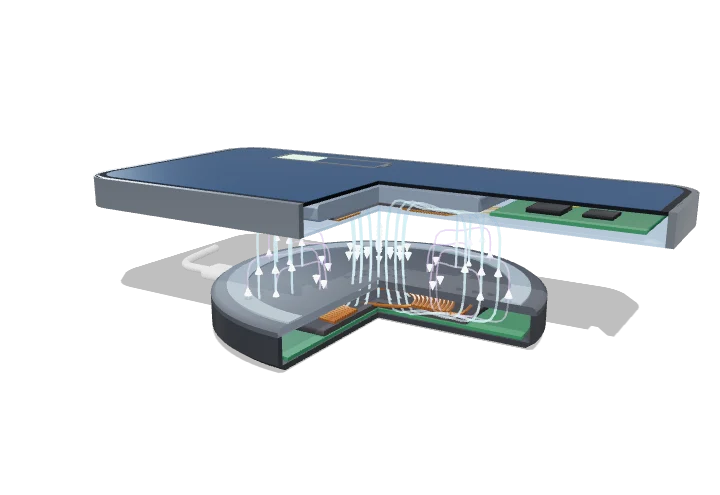 Open the interactive 3D model →
How does a phone charge just by lying on a pad, with no wire plugged in?
The charging pad and the phone each hide a flat coil of wire. Electricity rushing back and forth in the pad’s coil makes an invisible magnetic field that flips direction over a hundred thousand times a second. That flipping field passes through the phone’s coil and makes electricity flow in it, which charges the battery.
A Qi wireless charger is an air-gap transformer: an alternating current in a flat transmitter coil produces a changing magnetic field, and the part of that flux that threads the phone’s receiver coil induces a voltage there. Resonant capacitors, ferrite sheets and close alignment keep the coupling and efficiency high enough to charge a battery at 5–15 W.
Key facts
- Operating frequency
- ≈ 110–205 kHz (Qi Baseline Power Profile)
- Power levels
- 5 W (BPP), up to 15 W (EPP, Qi2 MPP)
- Coil-to-coil distance
- ≈ 3–5 mm through pad top and phone back
- Coupling coefficient k
- ≈ 0.3–0.7 when aligned; falls fast with offset
- End-to-end efficiency
- ≈ 70–80 % aligned (wired charging ≈ 85–95 %)
- Feedback link
- Receiver → pad by load modulation, ≈ 2 kbit/s
Parts you can explore (11)
- Transmitter coil
- Ferrite shield
- Inverter board
- Charging pad housing
- Power input
- Magnetic field
- Receiver coil
- Receiver ferrite
- Rectifier and charger IC
- Battery
- Phone body
In the 3D model
Rotate and take apart the model, follow a guided tour of what each part does and why it’s needed, change it with a live slider, and test yourself with a short quiz. Free, no sign-up.
Open Qi wireless charger in 3D →
OpenArc Models’ models are simplified teaching schematics. Terms · Privacy