Mechanisms
Tower windmill
Mechanisms · Historic power
 Open the interactive 3D model →
How did a brick tower with four wooden sails grind a village’s flour using nothing but the wind?
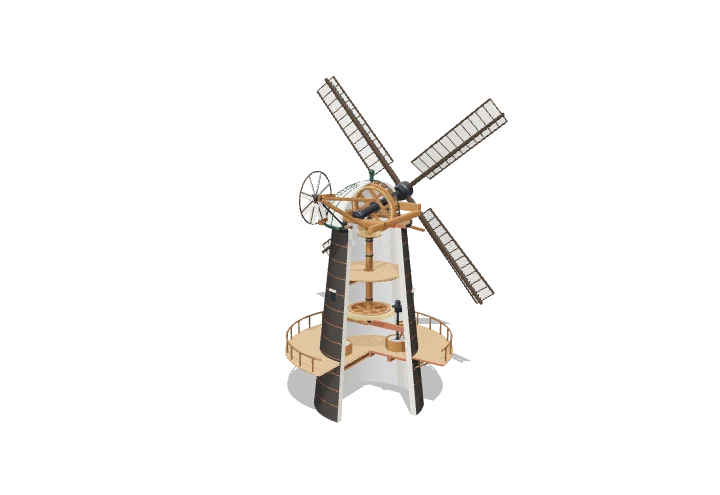
Wind pushes on the slanted sails and turns them slowly, about once every five seconds. Big wooden gears inside the tower speed that turning up about ten times and carry it down to a pair of heavy round stones that grind grain into flour. A little fan at the back keeps the sails pointing into the wind all by itself.
A tower windmill turns the kinetic energy of the wind into the rotation of millstones through a two-stage wooden and iron gear train. Its rotating cap, kept into the wind by a fantail, is an early example of automatic feedback control.
Key facts
- Sail span (model)
- 18 m (four 9 m sails)
- Typical sail speed
- ≈ 10–20 rpm
- Overall gear ratio (model)
- 72/34 × 96/20 ≈ 10.2
- Typical runner-stone speed
- ≈ 100–150 rpm for 1.2–1.4 m stones
- Typical power
- ≈ 5–30 kW at the windshaft in a working wind
- Fantail-to-cap gearing
- of order 3000 : 1
Parts you can explore (11)
- Tower
- Cap
- Sails
- Windshaft
- Brake wheel
- Wallower
- Main shaft
- Great spur wheel
- Stone nuts
- Millstones
- Fantail
In the 3D model
Rotate and take apart the model, follow a guided tour of what each part does and why it’s needed, change it with a live slider, and test yourself with a short quiz. Free, no sign-up.
OpenArc Models’ models are simplified teaching schematics. Terms · Privacy