Fluids & heat
Closed-return wind tunnel
Aerodynamics · Experimental facility
 Open the interactive 3D model →
How can engineers test a plane before it ever flies, by keeping it still and moving the air instead?
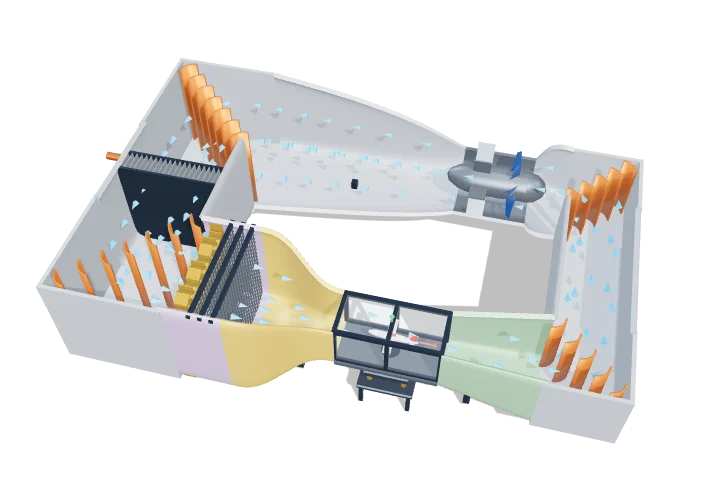
A wind tunnel is a big loop of pipe with a fan in it that blows air round and round. Before the air reaches the test model it is calmed and smoothed, then squeezed through a narrowing so it speeds up. A scale that holds the model measures how hard the air pushes it up (lift) and back (drag).
A closed-return wind tunnel circulates the same air round a loop: a fan makes up the losses, turning vanes guide the air round the corners, and a settling chamber with honeycomb and screens followed by a strong contraction delivers a fast, uniform, low-turbulence stream to the test section. Because the volume flow is the same at every cross-section, the speed at any point follows from continuity, V = Q/A.
Key facts
- Contraction ratio (this model)
- ≈ 6.1 (1.26 m → 0.51 m square)
- Test-section speed (this model)
- ≈ 26 m/s at 1200 rpm, ≈ 33 m/s at 1500 rpm
- Typical contraction ratios
- ≈ 6–10 for low-speed tunnels
- Turbulence intensity in good tunnels
- < 0.1 % in the test section
- Energy ratio (jet power / fan power)
- ≈ 3–7 for closed-return tunnels
- Incompressible range
- Mach < 0.3 (≈ 100 m/s at sea level)
Parts you can explore (14)
- Settling chamber
- Honeycomb
- Screens
- Contraction
- Test section
- Aircraft model
- Force balance
- Diffuser
- Turning vanes
- Return circuit
- Fan nacelle and straighteners
- Fan
- Cooler
- Flow tracers
In the 3D model
Rotate and take apart the model, follow a guided tour of what each part does and why it’s needed, change it with a live slider, and test yourself with a short quiz. Free, no sign-up.
Open Closed-return wind tunnel in 3D →
OpenArc Models’ models are simplified teaching schematics. Terms · Privacy