Power & energy
Wave energy converter
Renewable energy · Ocean power
 Open the interactive 3D model →
How can a wave that just goes up and down spin a turbine that only turns one way?
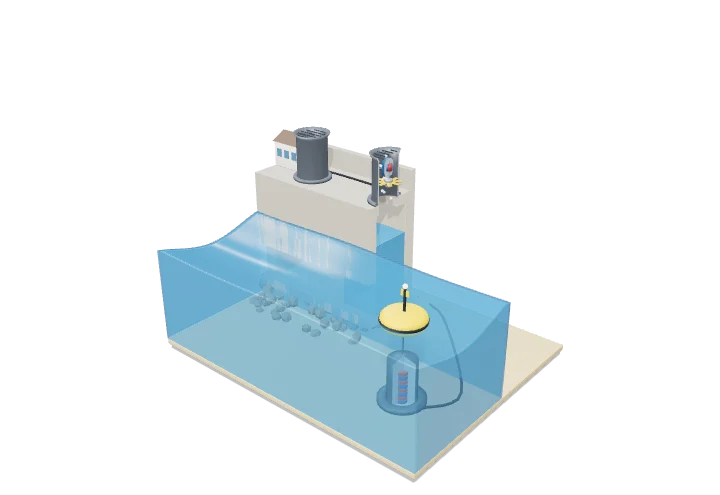
This wave power plant is a concrete box built into a harbour wall, open to the sea underneath. Waves make the water inside rise and fall like a piston, puffing air out through a hole in the roof and sucking it back in. A special turbine in that hole keeps spinning the same way whichever way the air blows, and turns a generator.
An oscillating water column (OWC) uses waves to drive a column of water up and down inside a partly submerged chamber, pumping air back and forth through a Wells turbine that spins in one direction regardless of the flow. A point-absorber buoy takes a different route, converting its heave directly into electricity with a linear generator, and in both cases the available power rises with the square of the wave height.
Key facts
- Wave power per metre of crest
- P ≈ 0.49 H²T kW m⁻¹ (deep water)
- Typical Atlantic resource
- ≈ 40–70 kW per metre of coastline (annual mean)
- Mutriku OWC, Spain
- 16 Wells turbines, ≈ 296 kW, operating since 2011
- Wells turbine speed
- ≈ 1500–3000 rpm (small machines)
- Wave periods
- ≈ 5–15 s for ocean swell
- Overall wave-to-wire efficiency
- Typically ≈ 10–30 %
Parts you can explore (12)
- Breakwater caisson
- Front wall (lip)
- Rubble mound and seabed
- Air duct
- Wells turbine
- Generator
- Internal water column
- Airflow
- Sea waves
- Point-absorber buoy
- Linear generator
- Control room and grid connection
In the 3D model
Rotate and take apart the model, follow a guided tour of what each part does and why it’s needed, change it with a live slider, and test yourself with a short quiz. Free, no sign-up.
Open Wave energy converter in 3D →
OpenArc Models’ models are simplified teaching schematics. Terms · Privacy