Fluids & heat
Water treatment plant
Environmental engineering · Drinking water
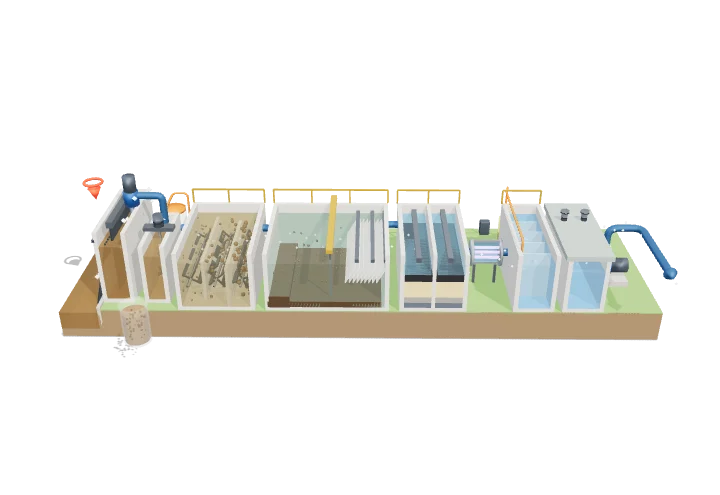 Open the interactive 3D model →
How does muddy river water become safe enough to drink straight from the tap?
A water treatment plant cleans river water in steps, like a relay race. First a chemical makes tiny specks of mud clump together, then the clumps sink, then sand filters catch what is left. Finally ultraviolet light and chlorine kill the germs, and a little chlorine stays in the water to keep it safe in the pipes.
A conventional surface-water treatment works removes particles and pathogens in a multi-barrier sequence: screening, coagulation and flocculation to turn fine colloids into settleable flocs, sedimentation and rapid sand filtration to remove them, then UV and chlorine disinfection. Each barrier removes a fraction of the contaminants, so together they achieve the many orders of magnitude (log) reduction needed for safe drinking water.
Key facts
- Raw river turbidity
- typically 5–100 NTU, > 1,000 NTU in floods
- Filtered-water target
- < 0.3 NTU (US rule: ≤ 0.3 NTU in 95 % of samples; good plants < 0.1)
- Flocculation
- G ≈ 10–70 s⁻¹ for 20–40 min
- Sedimentation
- ≈ 2–4 h detention; overflow rate ≈ 1–2.5 m/h
- Rapid sand filter rate
- ≈ 5–15 m/h
- Chlorine residual leaving works
- ≈ 0.2–1 mg/L free chlorine
Parts you can explore (13)
- Site and pipework
- Intake and screens
- Coagulation (rapid mix)
- Flocculation tanks
- Sedimentation basin
- Sludge
- Sand filters
- UV disinfection
- Chlorine contact tank
- Clear-water reservoir
- Distribution pump
- Sample jar
- Flow and stage marker
In the 3D model
Rotate and take apart the model, follow a guided tour of what each part does and why it’s needed, change it with a live slider, and test yourself with a short quiz. Free, no sign-up.
Open Water treatment plant in 3D →
OpenArc Models’ models are simplified teaching schematics. Terms · Privacy