Chemistry
Water & hydrogen bonding
General chemistry · Intermolecular forces
 Open the interactive 3D model →
Why does ice float, when almost every other solid sinks in its own liquid?
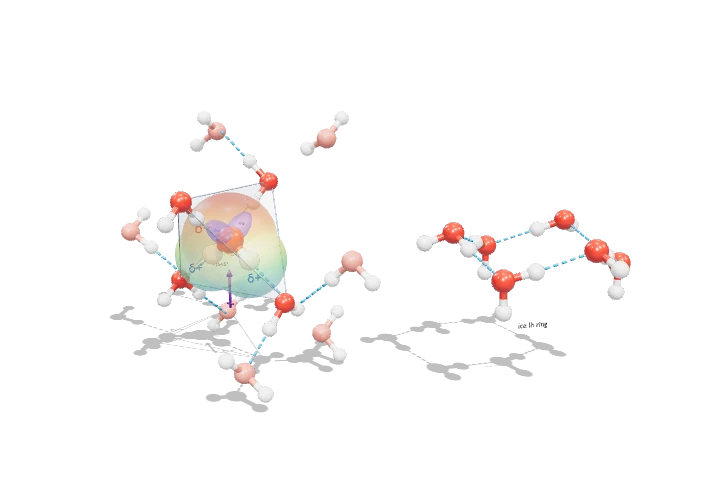
A water molecule is shaped like a bent V, with a slightly negative oxygen end and slightly positive hydrogen ends. These ends let each molecule cling to four neighbours with weak links called hydrogen bonds. In ice those links lock the molecules into an open, airy pattern — so ice is lighter than liquid water.
A water molecule is bent and strongly polar, with two O–H bonds that can donate hydrogen bonds and two lone pairs that can accept them. Because each molecule can make four hydrogen bonds arranged tetrahedrally, water forms an extended, constantly rearranging network that explains its unusually high boiling point, heat capacity and surface tension, and the low density of ice.
Key facts
- O–H bond length (gas)
- 0.957 Å
- H–O–H angle (gas)
- 104.5°
- Dipole moment
- 1.85 D (gas); ≈ 2.9 D average in the liquid
- Hydrogen-bond energy
- ≈ 20 kJ mol⁻¹ (gas dimer ≈ 21 kJ mol⁻¹ well depth)
- O···O distance
- 2.76 Å in ice Ih; ≈ 2.8 Å in the liquid
- Density, ice vs liquid at 0 °C
- 0.917 vs 1.000 g cm⁻³
Parts you can explore (11)
- Central water molecule
- Lone pairs
- Partial charges (δ+ / δ−)
- Dipole moment
- H–O–H bond angle
- First hydration shell
- Second shell
- Hydrogen bonds
- Tetrahedral coordination
- Electrostatic potential surface
- Ice Ih hexagonal ring
In the 3D model
Rotate and take apart the model, follow a guided tour of what each part does and why it’s needed, change it with a live slider, and test yourself with a short quiz. Free, no sign-up.
Open Water & hydrogen bonding in 3D →
OpenArc Models’ models are simplified teaching schematics. Terms · Privacy