Fluids & heat
Tank water heater
Heat transfer · Domestic hot water
 Open the interactive 3D model →
Why does a hot shower stay hot for ages, then turn cold almost all at once?
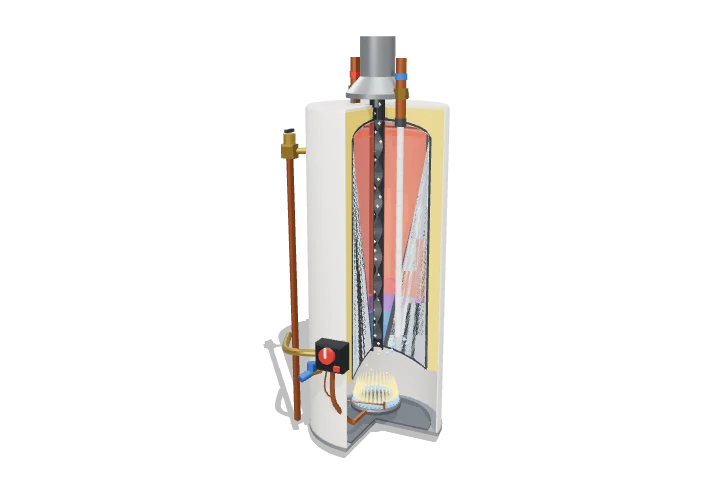
A water heater is a big insulated tank that keeps water hot, with a gas flame underneath. Hot water is lighter than cold, so it floats at the top where the hot tap draws from, while cold water comes in at the bottom. The cold layer rises like a lift until it reaches the top — and then your shower goes cold.
A storage water heater keeps a large volume of water hot in an insulated, glass-lined steel tank, heated here by a gas burner whose flue runs up through the water. Because hot water is less dense than cold, the tank stays stratified, so drawing from the top while cold water enters at the bottom delivers hot water at nearly constant temperature until the thermocline reaches the outlet.
Key facts
- Typical capacity
- 150–300 L (40–80 US gal)
- Stored temperature
- ≈ 49–60 °C (120–140 °F)
- Gas input (50 gal)
- ≈ 10–12 kW (35 000–40 000 Btu/h)
- Recovery
- ≈ 140–160 L/h at a 43 K rise
- T&P valve setting
- ≈ 99 °C and ≈ 10 bar (210 °F, 150 psi)
- Energy in a full tank
- ≈ 34 MJ (9.5 kWh) for 190 L from 12 to 55 °C
Parts you can explore (15)
- Outer jacket
- Foam insulation
- Steel tank and glass lining
- Hot water
- Cold water
- Dip tube
- Anode rod
- Inlet and outlet pipes
- Flue and baffle
- Burner and flame
- Gas control thermostat
- Draft hood and vent
- T&P relief valve
- Drain valve
- Water flow
In the 3D model
Rotate and take apart the model, follow a guided tour of what each part does and why it’s needed, change it with a live slider, and test yourself with a short quiz. Free, no sign-up.
Open Tank water heater in 3D →
OpenArc Models’ models are simplified teaching schematics. Terms · Privacy