Earth & space
Water cycle
Hydrology · Earth system
 Open the interactive 3D model →
Could the water in your glass once have fallen as snow on a mountain or flowed through a dinosaur?
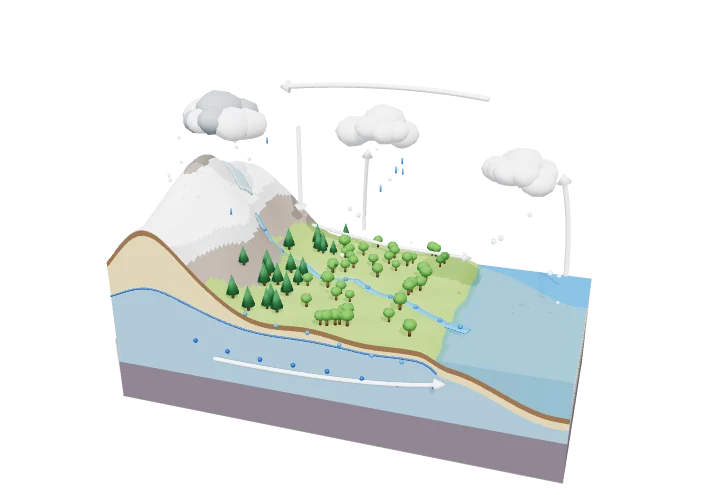
Earth’s water is constantly recycled. The Sun warms the sea so water rises into the air as invisible vapour, which cools into clouds and falls as rain or snow. That water then runs off in rivers or soaks underground, and eventually flows back to the sea to start again.
The water (hydrological) cycle moves water between the oceans, atmosphere, ice, land surface and groundwater, driven by solar energy and gravity. Evaporation and transpiration lift water as vapour, condensation forms clouds, precipitation returns it to the surface, and runoff and groundwater flow carry it back to the sea.
Key facts
- Ocean share of Earth’s water
- ≈ 96.5%
- Ice caps, glaciers and snow
- ≈ 1.7% of all water; ≈ 69% of fresh water
- Groundwater
- ≈ 1.7% of all water; ≈ 30% of fresh water
- Global precipitation
- ≈ 500,000 km³/yr (≈ 1 m/yr averaged over Earth)
- Water vapour residence time
- ≈ 8–10 days
- Latent heat of vaporisation
- ≈ 2.45 MJ/kg at 20 °C
Parts you can explore (15)
- Ocean
- Land surface and soil
- Bedrock
- Aquifer (saturated zone)
- Glacier and snowpack
- Forest
- River
- Clouds
- Evaporation
- Transpiration
- Precipitation
- Surface runoff
- Infiltration
- Groundwater flow
- Process arrows
In the 3D model
Rotate and take apart the model, follow a guided tour of what each part does and why it’s needed, change it with a live slider, and test yourself with a short quiz. Free, no sign-up.
OpenArc Models’ models are simplified teaching schematics. Terms · Privacy