Power & energy
Wankel rotary engine
Engines · Rotary internal combustion
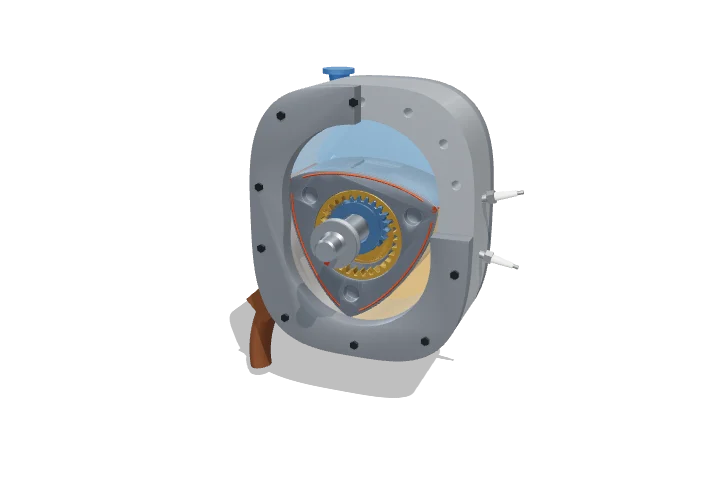 Open the interactive 3D model →
Can a car engine work with a spinning triangle instead of pistons going up and down?
A Wankel engine has a rounded triangle, called the rotor, that wobbles round inside a housing shaped like a fat figure eight. The three gaps between the triangle and the wall keep growing and shrinking, so each one can suck in fuel and air, squeeze it, burn it and push it out. There are no valves and no up-and-down pistons, so the engine is small, light and smooth.
A Wankel engine replaces reciprocating pistons with a triangular rotor that orbits eccentrically inside an epitrochoid housing, so that the three spaces between rotor and housing each run a complete four-stroke cycle. Phasing gears hold the rotor at one-third of shaft speed, giving one power pulse per shaft revolution per rotor with no valves, rods or reciprocating masses.
Key facts
- Rotor : shaft speed
- 1 : 3 (fixed by 2 : 3 phasing gears)
- Shaft rotation per stroke
- 270°
- Power pulses
- 1 per shaft revolution per rotor
- Mazda 13B geometry
- R = 105 mm, e = 15 mm, width 80 mm (K = R/e = 7)
- Chamber displacement (13B)
- 654 cm³ per rotor; 1308 cm³ for two rotors
- Typical compression ratio
- ≈ 9–10 : 1 (13B family)
Parts you can explore (11)
- Rotor housing
- Side housings
- Rotor
- Apex seals
- Eccentric shaft
- Stationary gear
- Internal rotor gear
- Intake port
- Exhaust port
- Spark plugs
- Working chambers
In the 3D model
Rotate and take apart the model, follow a guided tour of what each part does and why it’s needed, change it with a live slider, and test yourself with a short quiz. Free, no sign-up.
Open Wankel rotary engine in 3D →
OpenArc Models’ models are simplified teaching schematics. Terms · Privacy