Chemistry
VSEPR molecular shapes
General chemistry · Molecular geometry
 Open the interactive 3D model →
Why is a water molecule bent like a boomerang, while carbon dioxide is perfectly straight?
Around the central atom of a molecule, groups of electrons push each other as far apart as they can. Counting those groups tells you the shape. Some groups are bonds to other atoms; others are “lone pairs” that you cannot see but that still push.
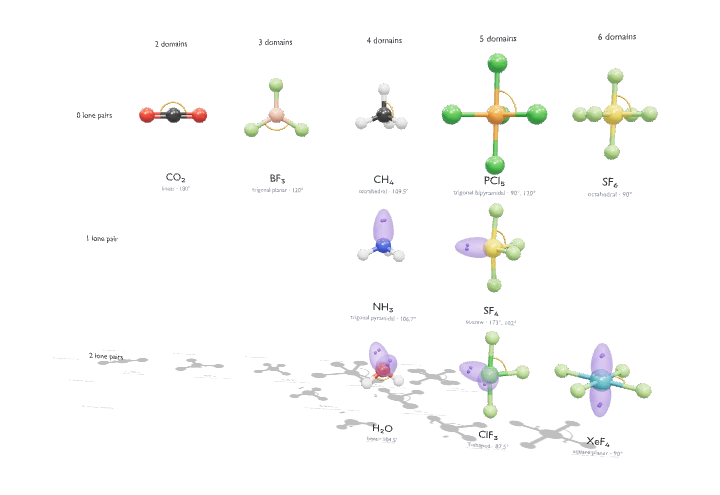
Valence-shell electron-pair repulsion (VSEPR) theory predicts molecular shape by assuming that the electron domains around a central atom — bonds and lone pairs — arrange themselves to be as far apart as possible. The number of domains fixes the electron geometry, and the positions of the atoms alone give the molecular shape, with lone pairs compressing the angles between bonds.
Key facts
- Electron domains
- 2 → 180°, 3 → 120°, 4 → 109.47°, 5 → 90°/120°, 6 → 90°
- Tetrahedral angle
- arccos(−1/3) = 109.47°
- Repulsion order
- lone pair–lone pair > lone pair–bond pair > bond pair–bond pair
- Bond angles, CH₄ → NH₃ → H₂O
- 109.5° → 106.7° → 104.5°
- Lone pairs in a trigonal bipyramid
- Always equatorial
- Lone pairs in an octahedron
- Trans (opposite each other)
Parts you can explore (13)
- Linear — CO₂
- Trigonal planar — BF₃
- Tetrahedral — CH₄
- Trigonal pyramidal — NH₃
- Bent — H₂O
- Trigonal bipyramidal — PCl₅
- Seesaw — SF₄
- T-shaped — ClF₃
- Octahedral — SF₆
- Square planar — XeF₄
- Lone pairs
- Bond-angle arcs
- Table headings
In the 3D model
Rotate and take apart the model, follow a guided tour of what each part does and why it’s needed, change it with a live slider, and test yourself with a short quiz. Free, no sign-up.
Open VSEPR molecular shapes in 3D →
OpenArc Models’ models are simplified teaching schematics. Terms · Privacy