Astronomy & space
Voyager spacecraft
Spaceflight · Deep-space probe
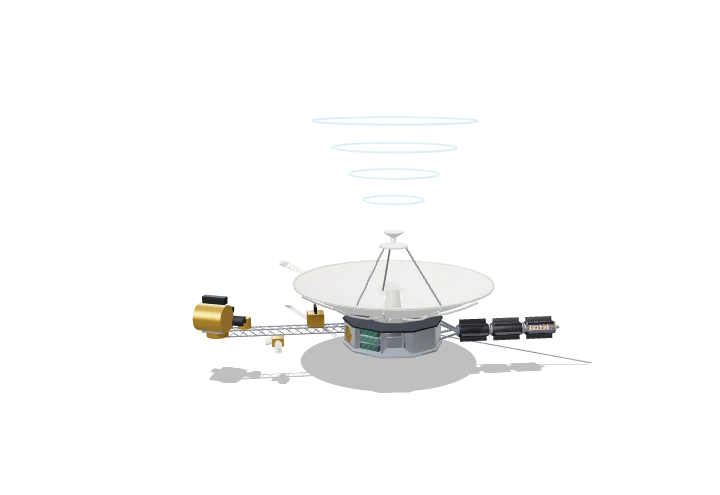 Open the interactive 3D model →
How does a spacecraft launched in 1977 still phone home from more than 20 billion kilometres away?
The two Voyager spacecraft flew past Jupiter, Saturn, Uranus and Neptune and are now beyond the Sun’s bubble of solar wind, in interstellar space. Each keeps a big dish pointed at Earth and runs on heat from radioactive plutonium, because sunlight that far out is far too weak. Their radio messages now take almost a day to reach us.
Voyager 1 and 2 are identical 1977 spacecraft that used rare planetary alignments and gravity assists to fly past Jupiter, Saturn, Uranus and Neptune, and are now the most distant working human-made objects. Their design — an Earth-pointing dish, nuclear power on a boom and instruments spread out on booms — is a lesson in engineering for distance, cold and decades of operation.
Key facts
- Launches
- Voyager 2: 20 Aug 1977; Voyager 1: 5 Sep 1977 (Titan IIIE–Centaur)
- Dry mass
- ≈ 722 kg each
- High-gain antenna
- 3.66 m dish; S-band (2.3 GHz) and X-band (8.4 GHz)
- Electrical power
- ≈ 470 W at launch from three Pu-238 RTGs; ≈ 4 W lost per year
- Heliopause crossings
- V1: Aug 2012 at ≈ 122 AU; V2: Nov 2018 at ≈ 119 AU
- Speed (V1)
- ≈ 17 km/s ≈ 3.6 AU per year relative to the Sun
Parts you can explore (11)
- High-gain antenna
- Electronics bus
- Hydrazine tank
- RTG boom
- RTGs
- Science boom
- Scan platform
- Magnetometer boom
- Plasma wave antennas
- Golden Record
- Radio link to Earth
In the 3D model
Rotate and take apart the model, follow a guided tour of what each part does and why it’s needed, change it with a live slider, and test yourself with a short quiz. Free, no sign-up.
Open Voyager spacecraft in 3D →
OpenArc Models’ models are simplified teaching schematics. Terms · Privacy