Earth & space
Volcano
Volcanology · Stratovolcano
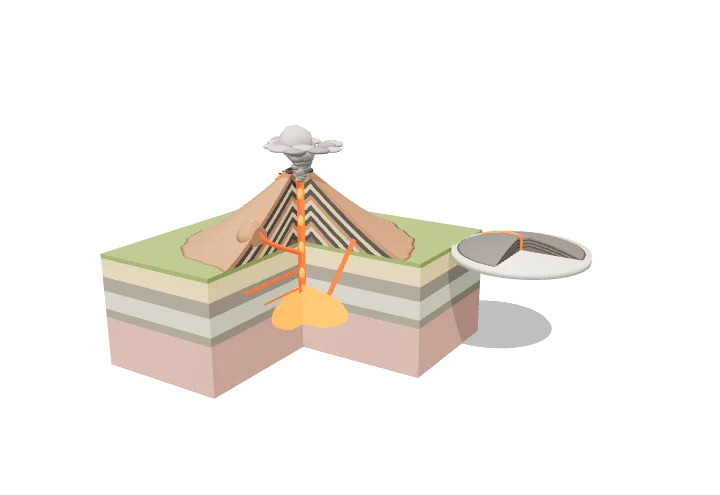 Open the interactive 3D model →
Why do some volcanoes ooze lava gently while others blow themselves apart?
Deep below a volcano, molten rock called magma collects in the crust. As it rises, gas dissolved in it forms bubbles, like a fizzy drink being opened. In runny magma the bubbles escape easily and lava pours out; in thick, sticky magma they are trapped until the magma shatters in an explosion of ash.
A stratovolcano is a steep cone built from alternating lava flows and explosive ash deposits, fed from a crustal magma reservoir through a conduit and a network of dikes and sills. Its viscous, gas-rich magma makes it far more explosive than a basaltic shield volcano, and the size of its eruptions is measured on the logarithmic Volcanic Explosivity Index.
Key facts
- Typical height above base
- ≈ 1–3 km (Fuji 3.8 km a.s.l.)
- Flank slopes
- up to ~30–35° near the summit; shields 2–10°
- Andesite magma temperature
- ≈ 900–1100 °C (basalt 1100–1250 °C)
- Magma viscosity
- andesite ~10⁵–10⁷ Pa·s; basalt ~10–10³ Pa·s
- Magma reservoir depth
- commonly ≈ 2–10 km
- VEI scale
- 0–8; each step ≈ 10× more tephra (from VEI 2 up)
Parts you can explore (12)
- Country rock
- Magma chamber
- Main conduit
- Lava and ash strata
- Crater
- Side vent
- Dike
- Sill
- Lava flow
- Eruption column
- Pyroclastic flow
- Shield volcano
In the 3D model
Rotate and take apart the model, follow a guided tour of what each part does and why it’s needed, change it with a live slider, and test yourself with a short quiz. Free, no sign-up.
OpenArc Models’ models are simplified teaching schematics. Terms · Privacy