Power & energy
Vertical-axis wind turbine
Renewable energy · Wind power
 Open the interactive 3D model →
Can a wind turbine work without ever turning to face the wind?
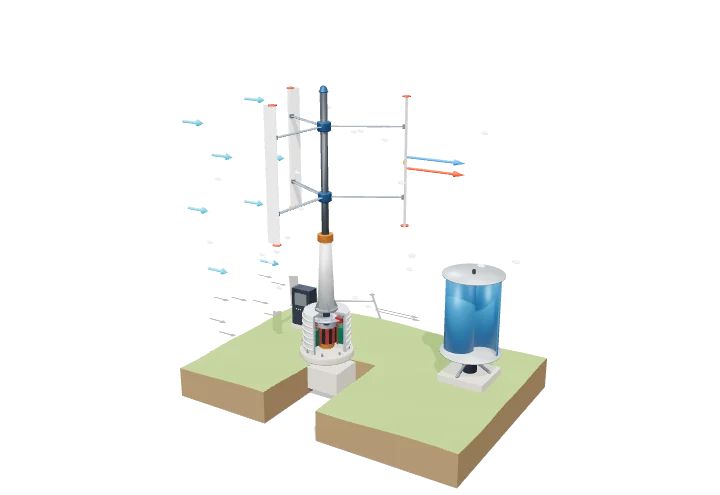
Most wind turbines look like giant propellers that must swing round to face the wind. A vertical-axis turbine spins around an upright pole instead, so it works whichever way the wind blows. Its thin blades are shaped like aircraft wings and are pulled round by lift, moving several times faster than the wind itself.
Vertical-axis wind turbines spin about an axis perpendicular to the wind, so they accept wind from any direction and can keep the generator at ground level. Lift-driven Darrieus rotors run at tip-speed ratios of about 3–4 and reach power coefficients of 0.3–0.4, while drag-driven Savonius rotors self-start easily but run near λ ≈ 1 with Cp of only 0.15–0.2.
Key facts
- Example H-rotor
- 6 m diameter × 4.8 m blades, 28.8 m² swept area, 10 kW rated
- Swept area (VAWT)
- A = D × H for straight blades
- Darrieus optimum
- λ ≈ 3–4.5, Cp ≈ 0.3–0.4
- Savonius optimum
- λ ≈ 0.8–1, Cp ≈ 0.15–0.2
- Angle of attack swing
- ≈ ±17° per revolution at λ = 3.5
- Betz limit (any open rotor)
- Cp ≤ 16/27 ≈ 0.593
Parts you can explore (11)
- Blades
- Struts
- Torque tube and hubs
- Mast and bearings
- Generator
- Brake
- Controller and inverter
- Foundation
- Savonius rotor
- Wind
- Velocity triangle
In the 3D model
Rotate and take apart the model, follow a guided tour of what each part does and why it’s needed, change it with a live slider, and test yourself with a short quiz. Free, no sign-up.
Open Vertical-axis wind turbine in 3D →
OpenArc Models’ models are simplified teaching schematics. Terms · Privacy