Human body
Vertebral column
Anatomy · Axial skeleton
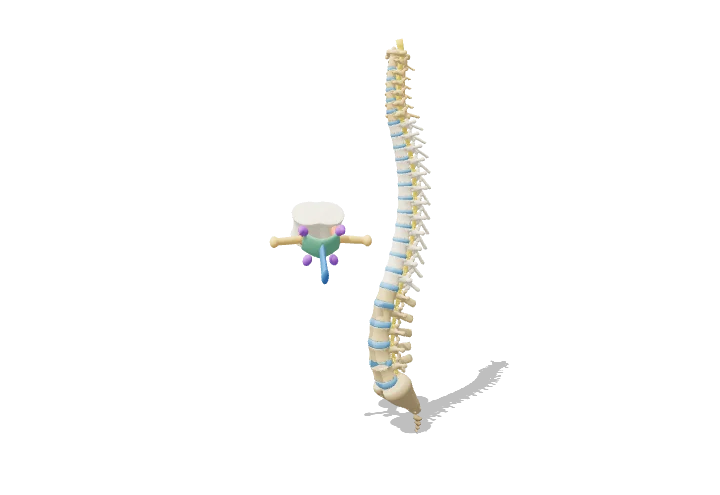 Open the interactive 3D model →
How can your backbone be strong enough to hold you up yet bendy enough to touch your toes?
Your backbone is a stack of 33 small bones called vertebrae, separated by squashy cushions called discs. Each joint moves only a little, but together they let your back bend and twist. The stack also forms a bony tunnel that protects your spinal cord.
The vertebral column is a stack of 33 vertebrae — 24 mobile ones separated by intervertebral discs, plus the fused sacrum and coccyx — that supports the trunk, protects the spinal cord and allows the back to bend and twist. Its four sagittal curves and region-specific vertebral shapes trade stiffness for mobility along its length.
Key facts
- Vertebrae
- 7 cervical, 12 thoracic, 5 lumbar, 5 fused sacral, 3–5 coccygeal
- Intervertebral discs
- 23 (C2–C3 to L5–S1); ≈ 20–25% of column length
- Adult column length
- ≈ 70 cm in men, ≈ 60 cm in women
- Normal curves
- Cervical lordosis ≈ 20–40°, thoracic kyphosis ≈ 20–45°, lumbar lordosis ≈ 40–60°
- Spinal cord length
- ≈ 42–45 cm; ends at about L1–L2
- L4–L5 disc pressure
- ≈ 0.5 MPa standing; ≈ 1.1 MPa bending forward; ≈ 2.3 MPa lifting 20 kg with a flexed back
Parts you can explore (14)
- Cervical vertebrae
- Thoracic vertebrae
- Lumbar vertebrae
- Sacrum
- Coccyx
- Intervertebral discs
- Nucleus pulposus
- Spinal cord
- Vertebral body
- Pedicles
- Laminae
- Spinous process
- Transverse processes
- Articular facets
In the 3D model
Rotate and take apart the model, follow a guided tour of what each part does and why it’s needed, change it with a live slider, and test yourself with a short quiz. Free, no sign-up.
OpenArc Models’ models are simplified teaching schematics. Terms · Privacy