Astronomy & space
Venus
Planetary science · Terrestrial planet
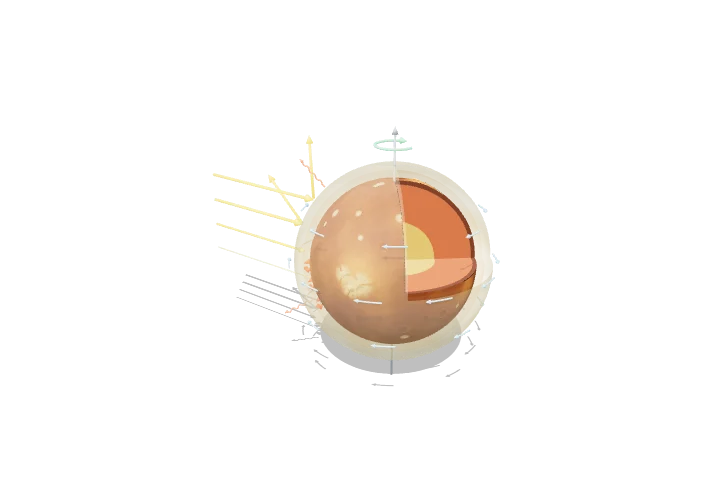 Open the interactive 3D model →
Why is Venus hotter than Mercury, even though it is twice as far from the Sun?
Venus is almost the same size as Earth, but it is wrapped in a crushingly thick blanket of carbon dioxide under clouds of sulfuric acid. Sunlight gets in, but the heat cannot get back out, so the surface is about 465 °C — hot enough to melt lead — day and night. Under the clouds is a rocky world of volcanoes, which we have mapped using radar.
Venus is almost Earth’s size and density, but a 92-bar carbon-dioxide atmosphere and global sulfuric-acid clouds give it a runaway greenhouse with a surface temperature near 465 °C. Beneath the clouds lies a young volcanic surface on a planet that rotates slowly backwards while its upper atmosphere races around it in about four days.
Key facts
- Radius
- 6,051.8 km (0.95 Earth)
- Surface temperature
- ≈ 465 °C (737 K), nearly uniform
- Surface pressure
- ≈ 92 bar (9.2 MPa)
- Atmosphere
- 96.5 % CO₂, 3.5 % N₂; H₂SO₄ clouds
- Rotation
- 243.0 d, retrograde; solar day 116.75 d
- Bond albedo
- ≈ 0.76
Parts you can explore (10)
- Cloud deck
- Lower atmosphere
- Surface and crust
- Volcanoes
- Mantle
- Core
- Sunlight
- Infrared trapping
- Super-rotating winds
- Retrograde rotation
In the 3D model
Rotate and take apart the model, follow a guided tour of what each part does and why it’s needed, change it with a live slider, and test yourself with a short quiz. Free, no sign-up.
OpenArc Models’ models are simplified teaching schematics. Terms · Privacy