Fluids & heat
Venturi carburettor
Fluid mechanics · Bernoulli in an engine
 Open the interactive 3D model →
How did old cars mix exactly the right amount of petrol into the air without a pump or a computer?
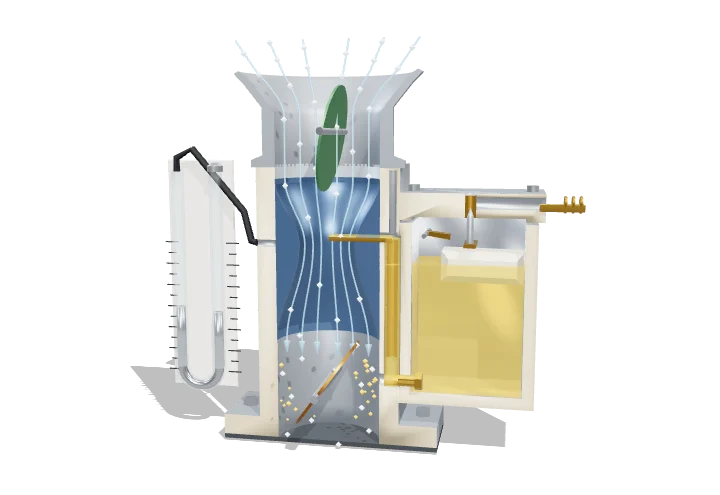
A carburettor makes air rush through a narrow pinch called a venturi. Fast-moving air has lower pressure, so the ordinary air pressure pressing on the petrol in a little bowl pushes fuel up a tube and sprays it into the airstream. The harder the engine breathes, the bigger the pressure drop and the more fuel it gets.
A carburettor meters fuel into an engine’s intake air using nothing but the pressure drop in a venturi: air accelerates through the narrow throat, its static pressure falls, and fuel stored at atmospheric pressure in the float bowl is pushed through a calibrated jet into the airstream. Because both the air and fuel flows depend on the same pressure difference, the mixture stays roughly in proportion as the throttle opens.
Key facts
- Stoichiometric air–fuel ratio (petrol)
- ≈ 14.7 : 1 by mass
- Best-power mixture
- ≈ 12.5–13.5 : 1
- Throat velocity at full throttle
- ≈ 50–100 m/s
- Venturi depression
- from tens of pascals to a few kPa
- Fuel lift head (nozzle above float level)
- a few millimetres (9 mm in the model)
- 1 mm Hg
- 133.3 Pa
Parts you can explore (12)
- Carburettor body
- Venturi
- Throttle butterfly
- Choke plate
- Fuel
- Main jet
- Discharge nozzle
- Float
- Needle valve
- Airflow
- Fuel spray
- Manometer
In the 3D model
Rotate and take apart the model, follow a guided tour of what each part does and why it’s needed, change it with a live slider, and test yourself with a short quiz. Free, no sign-up.
Open Venturi carburettor in 3D →
OpenArc Models’ models are simplified teaching schematics. Terms · Privacy