Physics
Van de Graaff generator
Electrostatics · High voltage
 Open the interactive 3D model →
How can a machine on a school bench build up hundreds of thousands of volts — and why doesn’t the spark kill you?
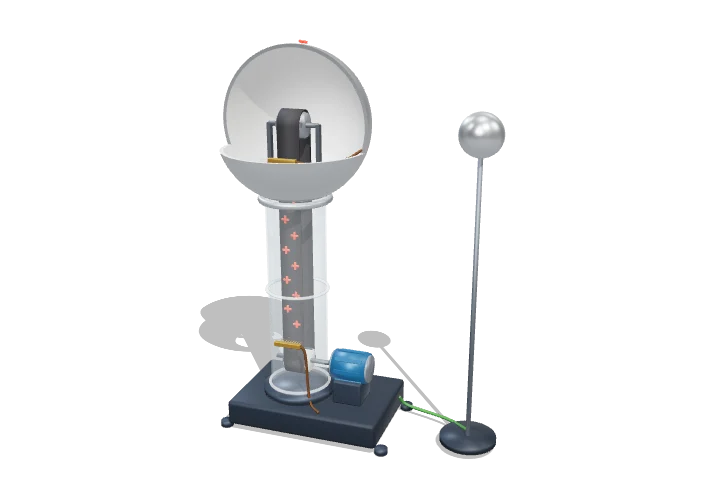
A Van de Graaff generator uses a moving rubber belt to carry electric charge up into a hollow metal ball, the dome. Charge keeps piling onto the outside of the dome until it reaches hundreds of thousands of volts and a spark jumps through the air. The total amount of charge is tiny, so the spark stings but is normally harmless.
A Van de Graaff generator uses an insulating belt to carry charge continuously into a hollow metal dome, where it spreads over the outer surface and raises the dome to a potential V = Q/(4πε₀R). The voltage climbs until charging is balanced by leakage or until the surrounding air breaks down in a spark.
Key facts
- Dome capacitance (R = 12 cm)
- C = 4πε₀R ≈ 13 pF
- Dielectric strength of dry air
- ≈ 3 MV/m at sea level
- Classroom maximum voltage
- ≈ 200–400 kV
- Charging current
- ~1–10 µA (classroom); up to ~mA in accelerators
- Charge on dome at 300 kV
- ≈ 4 µC
- Invented
- Robert J. Van de Graaff, 1929 (Princeton)
Parts you can explore (13)
- Metal dome
- Insulating column
- Rubber belt
- Upper roller
- Lower roller
- Lower comb
- Upper comb
- Motor
- Belt charges
- Dome surface charge
- Grounded sphere
- Spark discharge
- Base
In the 3D model
Rotate and take apart the model, follow a guided tour of what each part does and why it’s needed, change it with a live slider, and test yourself with a short quiz. Free, no sign-up.
Open Van de Graaff generator in 3D →
OpenArc Models’ models are simplified teaching schematics. Terms · Privacy