Mechanisms
Valve train
Mechanisms · Engines
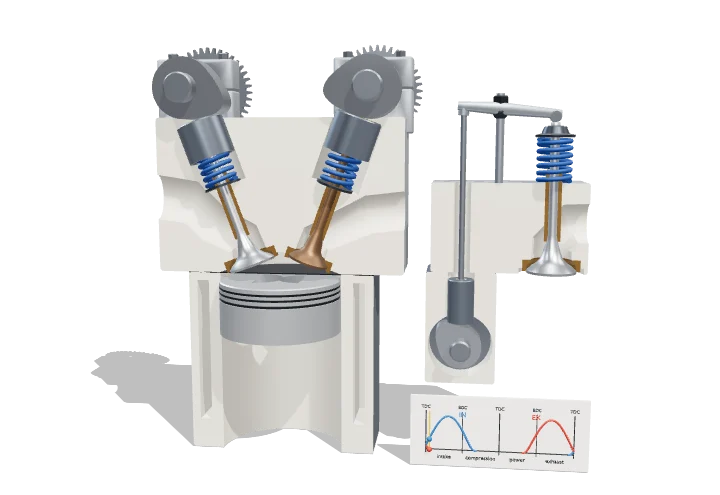 Open the interactive 3D model →
How does a car engine open and shut its valves up to 50 times a second, always at exactly the right moment?
An engine breathes through little doors called valves at the top of each cylinder. A spinning shaft with egg-shaped bumps — the camshaft — pushes each valve open as its bump comes round, and a spring snaps it shut again. The camshaft is geared to the engine so the timing never drifts.
A valve train converts the steady rotation of a camshaft, driven at half crankshaft speed, into the precisely timed opening and closing of an engine’s intake and exhaust poppet valves. The cam lobe’s shape fixes the lift, duration and accelerations of the valve, while the spring keeps the follower on the lobe — in a direct-acting overhead-cam head the lobe pushes a bucket tappet, in a pushrod (OHV) engine the motion travels through a lifter, pushrod and rocker arm.
Key facts
- Camshaft speed
- ½ × crankshaft speed (one valve event per 720° of crank)
- Model valve lift
- 9.5 mm (typical road engines 8–12 mm)
- Model timing (seat to seat)
- Intake 30° BTDC → 70° ABDC; exhaust 70° BBDC → 30° ATDC; 222° duration at 1 mm lift
- Lobe-separation angle
- 110 cam degrees (typical range 104–116°)
- Valve acceleration at 6000 rpm
- ≈ +560 g on the flanks, ≈ −240 g over the nose (this lift law)
- Pushrod rocker ratio
- 1.5 : 1 (common range 1.5–1.8)
Parts you can explore (14)
- Intake camshaft
- Exhaust camshaft
- Bucket tappets
- Valves
- Valve springs
- Retainers and collets
- Valve seats and guides
- Cylinder head
- Piston
- OHV camshaft and lifter
- Pushrod
- Rocker arm
- OHV valve and spring
- Valve lift diagram
In the 3D model
Rotate and take apart the model, follow a guided tour of what each part does and why it’s needed, change it with a live slider, and test yourself with a short quiz. Free, no sign-up.
OpenArc Models’ models are simplified teaching schematics. Terms · Privacy