Power & energy
V8 engine
Engines · Four-stroke internal combustion
 Open the interactive 3D model →
Why does a V8 engine rumble so smoothly when it is really just eight little explosions in a row?
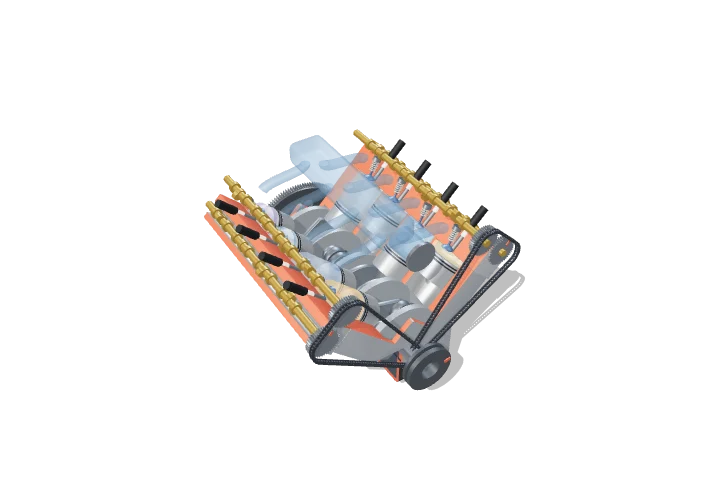
A V8 has eight cylinders arranged in two rows of four that form a V. In each cylinder a piston is pushed down by burning fuel, and all eight pistons turn the same crankshaft. Because the cylinders take turns firing, the crankshaft gets a push every quarter of a turn, which makes the engine smooth and powerful.
A V8 arranges eight cylinders in two banks of four at 90° around a single crankshaft, with one rod from each bank sharing every crankpin. Each cylinder runs a four-stroke Otto cycle over 720° of crank rotation, so one cylinder fires every 90°, and a cross-plane crankshaft with counterweights makes the engine almost perfectly balanced.
Key facts
- Bank angle
- 90°
- Firing interval
- 720° / 8 = 90° of crank rotation
- Firing order (model)
- 1-8-4-3-6-5-7-2 (GM small-block convention)
- Model geometry
- bore 96 mm × stroke 92 mm → 5.3 L
- Crankpin angles (cross-plane)
- 0°, 90°, 270°, 180° front to rear
- Camshaft speed
- ½ crankshaft speed
Parts you can explore (13)
- Engine block
- Pistons
- Connecting rods
- Crankshaft
- Flywheel
- Cylinder heads
- Camshafts
- Valves
- Timing chains
- Intake manifold
- Oil pan
- Spark plugs
- Combustion gases
In the 3D model
Rotate and take apart the model, follow a guided tour of what each part does and why it’s needed, change it with a live slider, and test yourself with a short quiz. Free, no sign-up.
OpenArc Models’ models are simplified teaching schematics. Terms · Privacy