Mechanisms
Universal joint
Mechanisms · Cardan joint kinematics
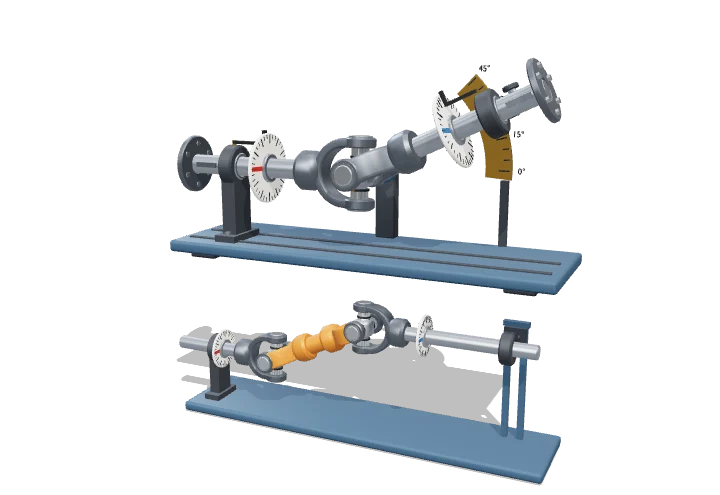 Open the interactive 3D model →
How can a spinning shaft turn a corner — and why does it speed up and slow down when it does?
A universal joint links two shafts that meet at an angle, using two forks joined by a small cross. It lets a car’s engine drive wheels that bounce up and down, or a steering wheel turn a shaft that bends round the engine. But when the shafts are bent, the output speeds up and slows down twice every turn, even though the input turns steadily.
A Cardan (Hooke’s) joint transmits rotation between two intersecting shafts through a cross whose two trunnion axes are held by perpendicular yokes. Because the cross must rock to satisfy both yokes, the output speed fluctuates between ω cos β and ω/cos β twice per revolution unless a second, correctly phased joint cancels the error.
Key facts
- Angle relation
- tan θ₂ = tan θ₁ / cos β
- Speed ratio range
- cos β ≤ ω₂/ω₁ ≤ 1/cos β
- Fluctuation frequency
- 2 cycles per shaft revolution
- At β = 30°
- ratio 0.866–1.155; phase error up to ±4.1°
- Typical working angles
- vehicle driveshafts ≈ 1–8°; steering columns up to ≈ 30°+
- Constant-velocity fix
- two joints in phase, equal angles (Z or W layout)
Parts you can explore (10)
- Input shaft
- Input yoke
- Cross (spider)
- Needle-bearing caps
- Output yoke
- Output shaft
- Base frame
- Bearings and swing arm
- Phase dials
- Double Cardan driveshaft
In the 3D model
Rotate and take apart the model, follow a guided tour of what each part does and why it’s needed, change it with a live slider, and test yourself with a short quiz. Free, no sign-up.
OpenArc Models’ models are simplified teaching schematics. Terms · Privacy