Chemistry
Metallic unit cells (SC, BCC, FCC, HCP)
Solid-state chemistry · Crystal packing
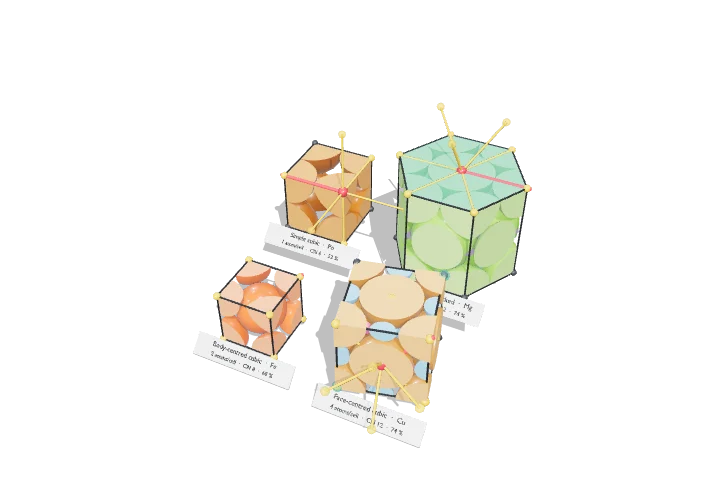 Open the interactive 3D model →
If you stack oranges at a market, what is the tightest way to pile them — and do metals do the same?
The atoms in a metal sit in a neat repeating pattern, like oranges stacked in a crate. The smallest box that repeats to build the whole crystal is called a unit cell. Metals use just a few patterns, and the best ones fill 74% of the space with atoms.
Most metallic elements crystallise in one of three structures — body-centred cubic, face-centred cubic or hexagonal close-packed — with simple cubic a rare curiosity. Counting atom fractions, nearest neighbours and filled volume in each unit cell explains metallic densities, radii and much of their mechanical behaviour.
Key facts
- Packing fraction
- SC 52.4 %, BCC 68.0 %, FCC = HCP 74.0 %
- Atoms per cell
- SC 1, BCC 2, FCC 4, HCP prism 6 (primitive cell 2)
- Coordination number
- SC 6, BCC 8, FCC 12, HCP 12
- Cu (FCC)
- a = 3.615 Å, r = 1.28 Å, ρ = 8.96 g cm⁻³
- α-Fe (BCC)
- a = 2.866 Å, r = 1.24 Å, ρ = 7.87 g cm⁻³
- Mg (HCP)
- a = 3.209 Å, c = 5.211 Å, c/a = 1.624 (ideal 1.633)
Parts you can explore (11)
- Simple cubic (Po)
- Body-centred cubic (Fe)
- Face-centred cubic (Cu)
- Hexagonal close-packed (Mg)
- Cell edges
- Lattice points
- Coordination shell
- Close-packed layers
- Contact directions
- Interstitial holes
- Name plates
In the 3D model
Rotate and take apart the model, follow a guided tour of what each part does and why it’s needed, change it with a live slider, and test yourself with a short quiz. Free, no sign-up.
Open Metallic unit cells (SC, BCC, FCC, HCP) in 3D →
OpenArc Models’ models are simplified teaching schematics. Terms · Privacy