Power & energy
Two-stroke engine
Engines · Crankcase-scavenged two-stroke
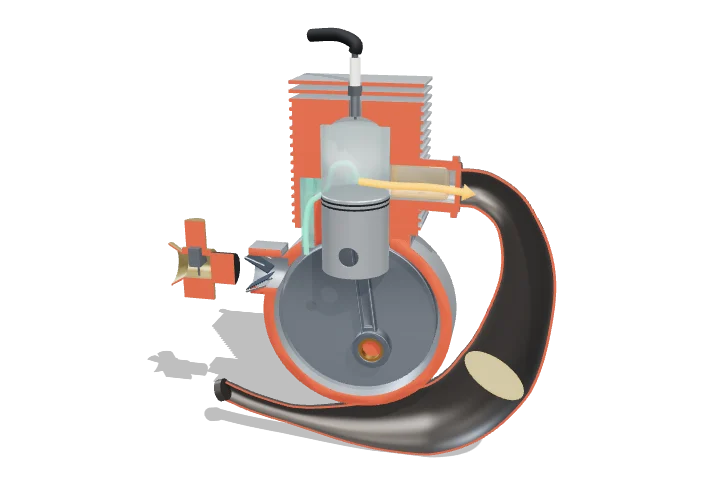 Open the interactive 3D model →
How does a chainsaw engine make so much power with almost no moving parts?
A two-stroke engine fires once every time the crankshaft goes round, twice as often as a car engine. It has no valves on top: the piston itself slides past holes (ports) in the cylinder wall, opening and closing them. The space under the piston works as a pump that pushes fresh fuel and air up into the cylinder.
A two-stroke engine completes its cycle in one crank revolution by using the piston as a valve: its crown uncovers exhaust and transfer ports in the cylinder wall near bottom dead centre, while the sealed crankcase below acts as a pump that pre-compresses the fresh charge. It fires every revolution, giving high power for its size and weight, at the cost of some fresh charge escaping with the exhaust.
Key facts
- Power strokes
- 1 per revolution (twice a four-stroke)
- Model geometry
- bore 54 mm × stroke 54.4 mm → 125 cm³
- Exhaust port timing (model)
- opens 85° after TDC → 190° duration
- Transfer port timing (model)
- opens 116° after TDC → 128° duration
- Crankcase (primary) compression ratio
- ≈ 1.3–1.5 : 1
- Racing 125 cc output
- ≈ 30–40 kW at 11 000–13 000 rpm
Parts you can explore (14)
- Cylinder
- Cylinder head
- Spark plug
- Piston
- Connecting rod
- Crankshaft
- Crankcase
- Reed valve
- Carburettor
- Transfer ports
- Exhaust port
- Expansion chamber
- Gas flows
- Combustion gases
In the 3D model
Rotate and take apart the model, follow a guided tour of what each part does and why it’s needed, change it with a live slider, and test yourself with a short quiz. Free, no sign-up.
Open Two-stroke engine in 3D →
OpenArc Models’ models are simplified teaching schematics. Terms · Privacy