Power & energy
Helicopter powertrain
Propulsion · Rotorcraft
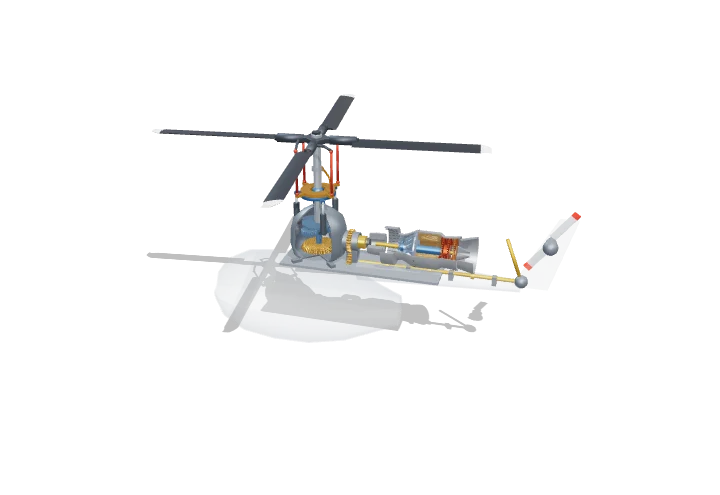 Open the interactive 3D model →
If a helicopter’s rotor always spins at the same speed, how does the pilot make it climb?
A helicopter engine spins the big rotor on top at a steady speed through a heavy gearbox. To climb, the pilot twists all the blades to a steeper angle so each one bites more air and lifts harder. A small rotor on the tail stops the body from spinning the opposite way.
A helicopter’s turboshaft engine delivers power through a freewheel unit and a main gearbox that reduces about 6,000 rpm to about 390 rpm at the rotor mast, with a branch to the tail rotor. The pilot controls lift and direction not by changing rotor speed but by changing blade pitch through the swashplate: collective changes all blades equally, cyclic changes them once per revolution.
Key facts
- Main rotor speed (light helicopter)
- ≈ 390–400 rpm, held constant
- Rotor tip speed
- ≈ 210–220 m/s (Mach ≈ 0.65)
- Engine output shaft speed
- ≈ 6,000 rpm (power turbine ≈ 33,000–40,000 rpm)
- Main gearbox reduction
- ≈ 15 : 1 (bevel + planetary)
- Disk loading
- ≈ 200–350 N/m² for light helicopters
- Tail-rotor share of power
- ≈ 8–12 % in hover
Parts you can explore (13)
- Turboshaft engine
- Free power turbine
- Drive shaft and freewheel
- Main gearbox
- Rotor mast
- Swashplate
- Hydraulic servos
- Pitch links
- Rotor hub
- Main rotor blades
- Tail rotor drive shaft
- Tail rotor and gearboxes
- Airframe (outline)
In the 3D model
Rotate and take apart the model, follow a guided tour of what each part does and why it’s needed, change it with a live slider, and test yourself with a short quiz. Free, no sign-up.
Open Helicopter powertrain in 3D →
OpenArc Models’ models are simplified teaching schematics. Terms · Privacy