Power & energy
Turboprop engine
Propulsion · Gas turbine
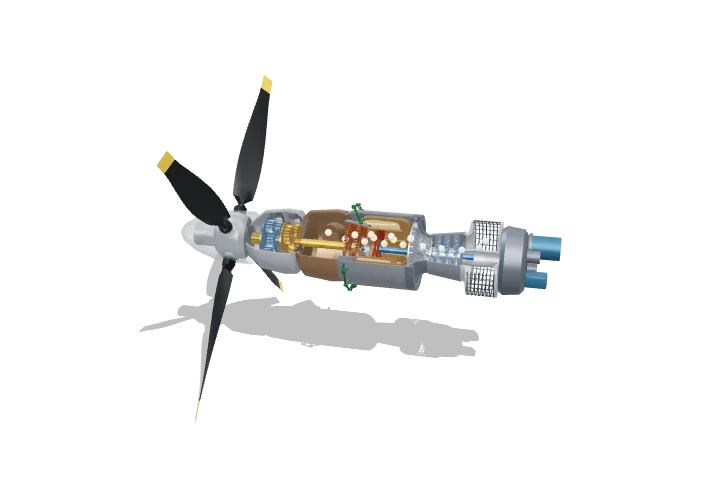 Open the interactive 3D model →
Why do many small airliners still have propellers, even though they are powered by jet-style engines?
A turboprop is a jet-style engine that spins a propeller instead of blasting out a fast jet. Hot gas from burning fuel spins turbines, and the turbines turn the propeller through a set of gears. At the speeds of short flights, a big propeller moves air very efficiently, so it burns less fuel than a jet.
A turboprop is a gas turbine that delivers nearly all of its output as shaft power, which a reduction gearbox and a variable-pitch propeller turn into thrust. In the PT6-style free-turbine layout the compressor turbine and the power turbine are on separate shafts, and a governor holds propeller speed constant by changing blade pitch as power changes.
Key facts
- Shaft power (PT6A family)
- ≈ 500–1,900 shp (≈ 370–1,400 kW)
- Overall pressure ratio
- ≈ 7–12 : 1 (axial stages + one centrifugal stage)
- Gearbox reduction
- ≈ 15–17 : 1, two planetary stages
- Propeller speed
- ≈ 1,700–2,200 rpm, held constant by the governor
- Turbine inlet temperature
- ≈ 1,250–1,400 K (model-dependent)
- Specific fuel consumption
- ≈ 0.30–0.40 kg per kWh of shaft power
Parts you can explore (12)
- Propeller
- Pitch-change mechanism
- Reduction gearbox
- Exhaust duct
- Power turbine
- Compressor turbine
- Combustor
- Centrifugal compressor
- Axial compressor
- Air inlet
- Accessory gearbox
- Gas flow
In the 3D model
Rotate and take apart the model, follow a guided tour of what each part does and why it’s needed, change it with a live slider, and test yourself with a short quiz. Free, no sign-up.
OpenArc Models’ models are simplified teaching schematics. Terms · Privacy