Power & energy
Turbocharger
Engines · Forced induction
 Open the interactive 3D model →
How can a small car engine make the power of a big one just by recycling its own exhaust?
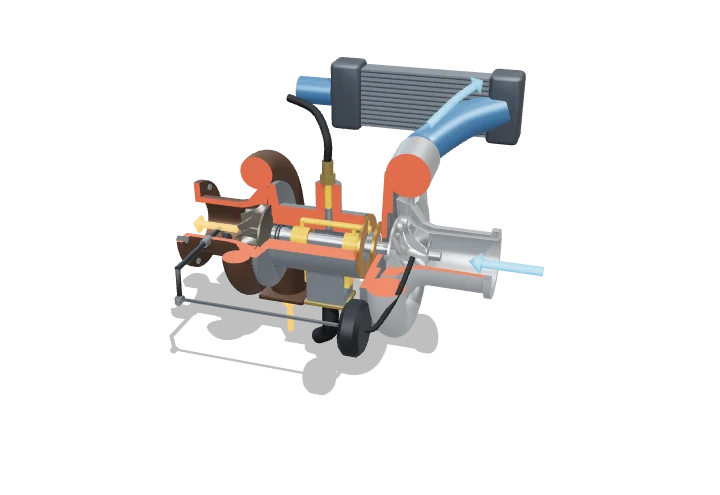
A turbocharger uses the hot exhaust leaving an engine to spin a little windmill, called a turbine. The turbine is joined by a shaft to a fan that squeezes extra air into the engine. More air lets the engine burn more fuel, so it makes more power.
A turbocharger uses a radial turbine, driven by the engine’s exhaust gas, to spin a centrifugal compressor on the same shaft and raise the density of the air entering the engine. More air per cycle lets the engine burn more fuel, so a smaller turbocharged engine can match a larger naturally aspirated one, while a wastegate keeps boost within safe limits.
Key facts
- Shaft speed (small automotive turbo)
- ≈ 100 000–250 000 rpm
- Wheel diameters (model)
- compressor ≈ 50 mm, turbine ≈ 45 mm
- Typical boost
- ≈ 0.5–2 bar gauge (pressure ratio ≈ 1.5–3)
- Compressor isentropic efficiency
- ≈ 70–80%
- Turbine inlet temperature
- up to ≈ 950 °C (diesel) / 1050 °C (petrol)
- Compressor outlet temperature at pressure ratio 2.2
- ≈ 120–130 °C before the intercooler
Parts you can explore (11)
- Turbine housing
- Turbine wheel
- Shaft
- Bearings
- Bearing housing
- Oil feed and drain
- Compressor wheel
- Compressor housing
- Wastegate
- Intercooler connection
- Gas flows
In the 3D model
Rotate and take apart the model, follow a guided tour of what each part does and why it’s needed, change it with a live slider, and test yourself with a short quiz. Free, no sign-up.
OpenArc Models’ models are simplified teaching schematics. Terms · Privacy