Earth & space
Tsunami
Earth science · Ocean hazards
 Open the interactive 3D model →
How can a wave less than a metre high in the open ocean become a wall of water that floods a city?
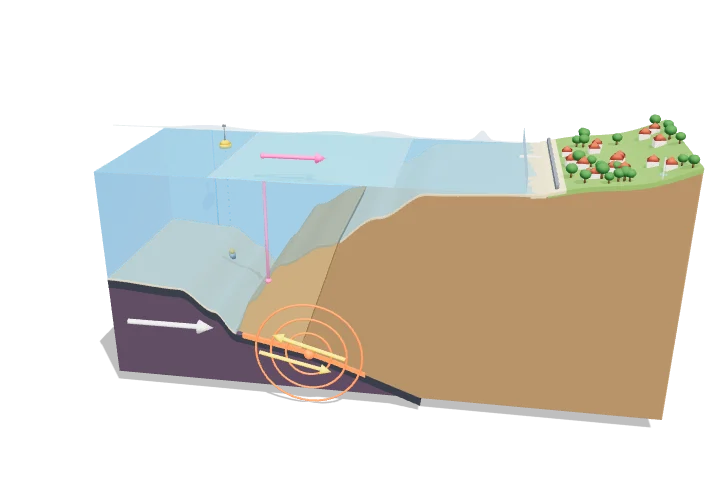
A tsunami starts when an undersea earthquake suddenly lifts the sea floor, pushing up the whole ocean above it. The bulge spreads out as waves that race across deep water as fast as a jet plane, yet are so low that ships barely notice them. Near the coast the water gets shallow, the waves slow down and pile up, and they surge far inland.
A tsunami is a series of very long ocean waves generated when a large volume of water is suddenly displaced, most often by vertical seafloor motion in a subduction-zone megathrust earthquake. Because its wavelength far exceeds the ocean depth it travels as a shallow-water wave at √(gd), crossing ocean basins at jet-aircraft speed and growing dramatically as it slows over the continental shelf.
Key facts
- Deep-ocean speed
- ≈ 200 m/s (≈ 710 km/h) over 4000 m of water
- Deep-ocean wavelength
- ≈ 100–500 km
- Deep-ocean height
- typically < 1 m
- Wave period
- ≈ 5–60 min
- Main source
- ≈ 80% of tsunamis occur in the Pacific, mostly from subduction earthquakes
- Largest recorded run-up (earthquake)
- ≈ 40 m (Tōhoku, Japan, 2011)
Parts you can explore (11)
- Oceanic plate
- Overriding plate
- Megathrust rupture
- Ocean
- Tsunami wave
- Seaward wave
- Shoaling profiles
- Run-up and inundation
- Coastal town
- DART buoy
- Depth probe
In the 3D model
Rotate and take apart the model, follow a guided tour of what each part does and why it’s needed, change it with a live slider, and test yourself with a short quiz. Free, no sign-up.
OpenArc Models’ models are simplified teaching schematics. Terms · Privacy