Plants & animals
Tree trunk
Botany · Secondary growth
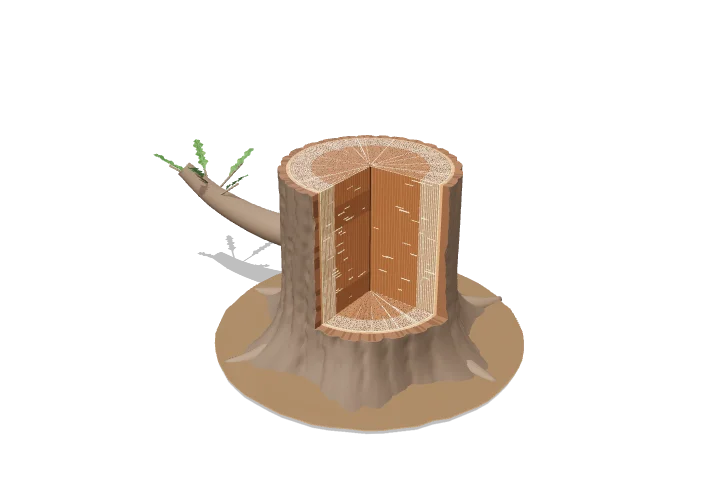 Open the interactive 3D model →
Why does a tree trunk have rings — and how can they tell you about a drought 500 years ago?
A tree trunk gets wider, not taller, by adding a new layer of wood every year just under the bark. Wood made in spring is light and open; wood made in summer is dark and dense, so each year leaves a ring. Wet years make wide rings and dry years make narrow ones, so the rings are a diary of the tree’s life.
A tree trunk thickens by secondary growth: each growing season the vascular cambium adds a layer of xylem (wood) on its inside and phloem on its outside, producing annual rings, while a cork cambium renews the bark. Only the outer sapwood conducts water; older inner rings become heartwood that supports the tree and resists decay.
Key facts
- Growth layer
- Vascular cambium, a few cells thick
- Rings per year
- 1 in seasonal climates (false or missing rings occur)
- Typical ring width
- ≈ 1–10 mm, depending on species, age and climate
- Wood type shown
- Ring-porous hardwood (oak-like)
- Sapwood in oak
- Roughly the outer 10–30 rings, a few cm thick
- Model age
- 30 years, trunk ≈ 36 cm across
Parts you can explore (10)
- Outer bark
- Inner bark (phloem)
- Vascular cambium
- Sapwood
- Heartwood
- Annual rings
- Rays
- Pith
- Branch
- Roots
In the 3D model
Rotate and take apart the model, follow a guided tour of what each part does and why it’s needed, change it with a live slider, and test yourself with a short quiz. Free, no sign-up.
OpenArc Models’ models are simplified teaching schematics. Terms · Privacy