Mechanisms
Counterweight trebuchet
Mechanisms · Medieval engineering
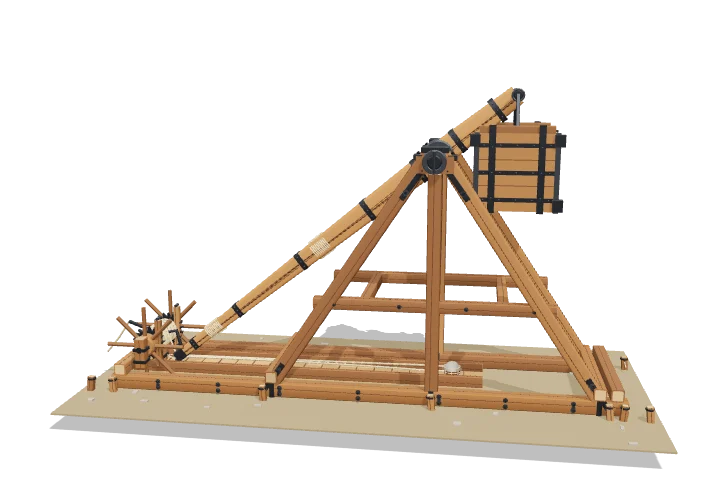 Open the interactive 3D model →
How did a medieval siege engine fling a stone heavier than a person hundreds of metres, using only gravity?
A trebuchet is a giant see-saw. A huge box of stones on the short end falls, swinging the long end up very fast. A rope sling on the tip whips round even faster, like flicking a towel, and lets go of the stone at just the right moment.
A counterweight trebuchet converts the gravitational potential energy of a raised mass into the kinetic energy of a projectile, using a lever arm and a sling as a two-stage speed amplifier. It is a classic problem in Lagrangian mechanics: a coupled multi-pendulum whose release timing sets the launch angle and range.
Key facts
- Counterweight : projectile mass
- typically ≈ 50 : 1 to 150 : 1
- Arm ratio (long : short)
- ≈ 3 : 1 to 6 : 1 (model 3.75 : 1)
- Model machine
- axle 6 m high, arm 11.4 m, sling 7.5 m
- Energy efficiency
- ≈ 50–70 % for a well-tuned hinged design (model ≈ 47–70 %)
- Typical medieval range
- ≈ 150–300 m with 50–150 kg stones
- Throw duration
- ≈ 1–2 s from trigger to release
Parts you can explore (10)
- Frame
- Axle
- Throwing arm
- Counterweight box
- Sling
- Release pin
- Projectile
- Trough
- Trigger
- Winch
In the 3D model
Rotate and take apart the model, follow a guided tour of what each part does and why it’s needed, change it with a live slider, and test yourself with a short quiz. Free, no sign-up.
Open Counterweight trebuchet in 3D →
OpenArc Models’ models are simplified teaching schematics. Terms · Privacy