Physics
Transverse wave on a string
Physics · Waves
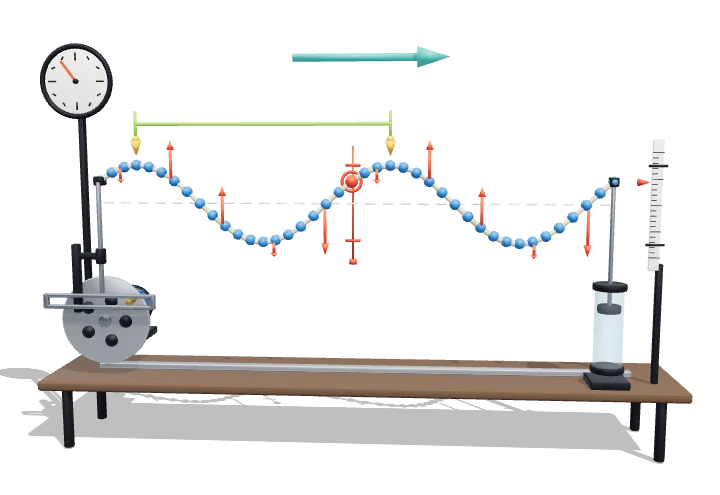 Open the interactive 3D model →
When you flick a rope, the bump races to the far end — so why doesn’t the rope go with it?
A wave is a moving pattern, not moving stuff. Each little piece of the rope only goes up and down, but it copies the piece next to it a moment later, so the shape travels along. The energy you put in at one end really does arrive at the other.
A transverse wave on a stretched string is a travelling disturbance in which each element moves perpendicular to the direction of propagation, while the wave pattern and its energy move along the string. Its speed is set by the medium, v = √(T/μ), and the source sets the frequency, so the wavelength follows from v = fλ.
Key facts
- Wave relation
- v = fλ, with k = 2π/λ and ω = 2πf
- Speed on a string
- v = √(T/μ)
- Model rope
- T = 18 N, μ = 0.5 kg/m → v = 6.0 m/s
- Model range
- λ = 1–4 m ↔ f = 6.0–1.5 Hz (shown 4× slower)
- Power carried
- P = ½ μ ω² A² v (≈ 48 W at the default λ = 2 m)
- Guitar high-E string
- ≈ 73 N tension, v ≈ 430 m/s
Parts you can explore (12)
- Medium particles
- Connecting string
- Wave driver
- Transverse velocity arrows
- Wavelength guide
- Crest markers
- Equilibrium axis
- Tracer particle
- Propagation arrow
- Amplitude gauge
- Frequency clock
- End supports
In the 3D model
Rotate and take apart the model, follow a guided tour of what each part does and why it’s needed, change it with a live slider, and test yourself with a short quiz. Free, no sign-up.
Open Transverse wave on a string in 3D →
OpenArc Models’ models are simplified teaching schematics. Terms · Privacy