Cells & molecules
Transcription by RNA polymerase II
Molecular biology · Gene expression
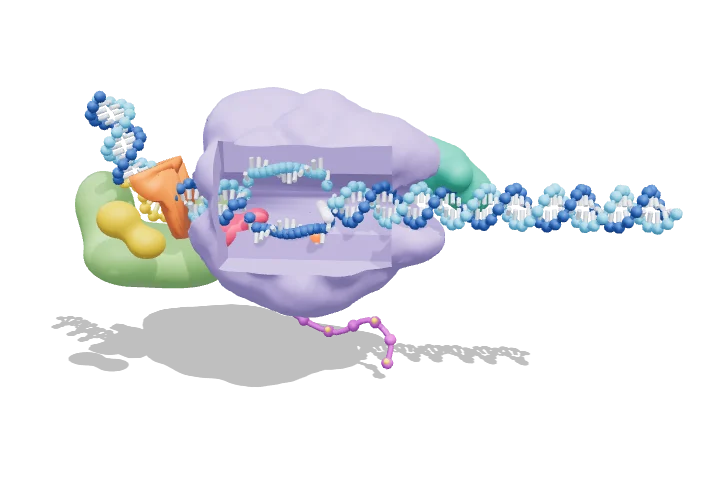 Open the interactive 3D model →
Your genes stay locked in the nucleus — so how do their instructions get out to build anything?
Genes are stored as DNA inside the nucleus, but proteins are built outside it. An enzyme called RNA polymerase II unzips a small stretch of DNA, reads one strand letter by letter, and builds a matching copy out of RNA. That copy, called messenger RNA (mRNA), gets a protective cap and travels out to be read.
In eukaryotes, RNA polymerase II transcribes protein-coding genes after general transcription factors assemble it on the promoter. The enzyme opens a short bubble of DNA, copies the template strand into pre-mRNA 5′→3′, and the transcript is capped as it emerges.
Key facts
- Transcription bubble
- ≈ 12–14 bp unwound
- RNA–DNA hybrid
- ≈ 8–9 bp
- Elongation rate (human genes)
- ≈ 1–4 kb/min (≈ 15–70 nt/s)
- Pol II size
- 12 subunits, ≈ 550 kDa
- TATA box position
- ≈ −25 to −31 relative to the start site
- Capping
- after ≈ 20–30 nt of RNA
Parts you can explore (14)
- Promoter and flanking DNA
- TATA box
- Template strand
- Coding strand
- RNA polymerase II
- Active site
- CTD tail
- mRNA transcript
- 5′ cap
- TBP
- TFIID
- TFIIA
- TFIIB
- TFIIH
In the 3D model
Rotate and take apart the model, follow a guided tour of what each part does and why it’s needed, change it with a live slider, and test yourself with a short quiz. Free, no sign-up.
Open Transcription by RNA polymerase II in 3D →
OpenArc Models’ models are simplified teaching schematics. Terms · Privacy