Mechanisms
Traction elevator
Machines · Friction drives and counterweights
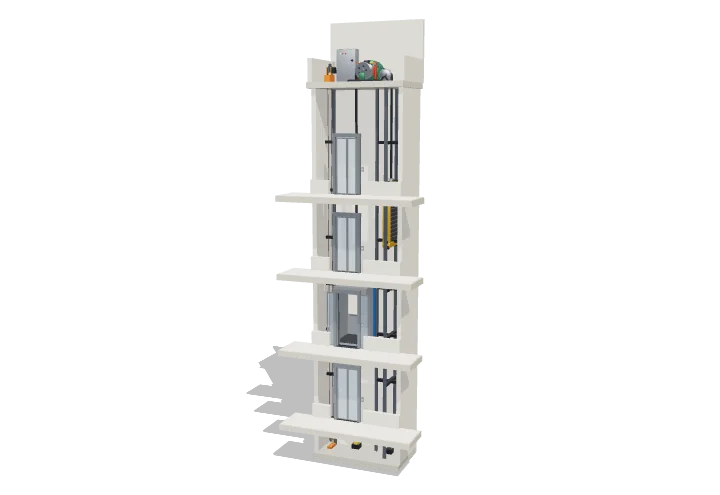 Open the interactive 3D model →
What actually stops a lift from crashing to the bottom if its cables snap?
A lift car hangs from steel ropes that run over a wheel at the top of the shaft and down to a heavy counterweight on the other side. The two nearly balance, so the motor only has to push the difference. Several separate safety systems — springs that brake, a speed sensor and clamps that grip the rails — make sure the car can never fall freely.
A traction elevator hangs the car and a counterweight on opposite ends of steel ropes and drives the ropes by friction over a grooved sheave, so the motor only supplies the out-of-balance force. Layers of safety — brake, overspeed governor, safety gear, buffers and door interlocks — make it one of the safest forms of transport.
Key facts
- Model
- 4 stops, 3.0 m floor to floor, 1.0 m/s, 630 kg (8 persons)
- Roping
- 1:1, four ropes
- Counterweight
- car weight + ≈ 40–50 % of rated load
- Comfortable acceleration
- ≈ 0.8–1.2 m/s²
- Governor tripping speed
- ≥ 115 % of rated speed
- Fastest installations
- ≈ 20 m/s (supertall towers)
Parts you can explore (15)
- Hoistway
- Machine room
- Guide rails
- Car
- Car frame & guide shoes
- Safety gear
- Counterweight
- Hoist ropes
- Traction machine
- Brake
- Deflector sheave
- Overspeed governor
- Buffers
- Controller
- Landing doors
In the 3D model
Rotate and take apart the model, follow a guided tour of what each part does and why it’s needed, change it with a live slider, and test yourself with a short quiz. Free, no sign-up.
Open Traction elevator in 3D →
OpenArc Models’ models are simplified teaching schematics. Terms · Privacy