Mechanisms
Tower crane
Machines · Load moment and stability
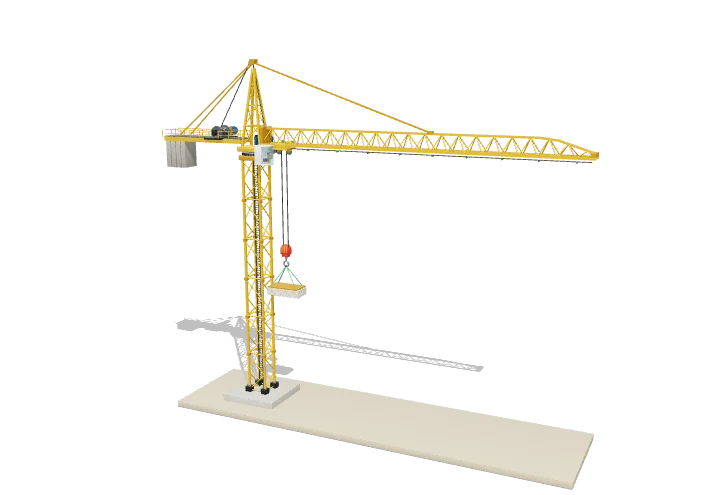 Open the interactive 3D model →
Why doesn’t a tower crane topple over when it swings a heavy load far out on its long arm?
A tower crane is a giant see-saw balanced on a tall tower. The long arm carries the load on a little trolley, and heavy concrete blocks on the short back arm balance it. What matters is not just how heavy the load is but how far out it hangs — so the heavier the load, the closer in it must stay.
A tower crane is a balanced lever on a tall column: the jib carries the load on a moving trolley, while counterweights on a shorter counter-jib keep the out-of-balance moment on the mast within limits. Its capacity is set by load moment (load × radius), so the heavier the load, the shorter the radius at which it may be carried.
Key facts
- Model crane
- 41 m jib, 8 t maximum load, 2.9 t at the tip
- Rated moment (simplified chart)
- 120 t·m
- Height under hook (model)
- ≈ 31 m on six 5.2 m sections
- Reeving
- 2 falls (single-sheave hook block)
- Typical slewing speed
- ≈ 0.5–0.8 rpm
- Typical in-service wind limit
- ≈ 20 m/s (≈ 72 km/h)
Parts you can explore (13)
- Foundation
- Mast sections
- Slewing unit
- Tower head & pendants
- Operator cab
- Jib
- Trolley
- Hook block
- Hoist rope
- Counter-jib
- Counterweights
- Hoist winch
- Load
In the 3D model
Rotate and take apart the model, follow a guided tour of what each part does and why it’s needed, change it with a live slider, and test yourself with a short quiz. Free, no sign-up.
OpenArc Models’ models are simplified teaching schematics. Terms · Privacy