Physics
Total internal reflection
Geometric optics · Refraction and reflection
 Open the interactive 3D model →
How can a thread of glass carry light under an ocean without the light leaking out of its sides?
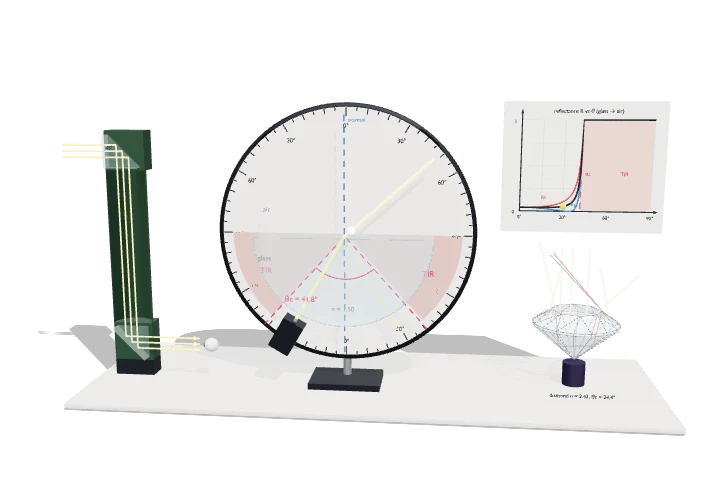
When light inside glass reaches the surface, part of it escapes into the air and bends, and part bounces back. If the light hits the surface at a steep enough slant, none of it can escape and every bit bounces back inside. This perfect bounce, called total internal reflection, guides light along optical fibres and makes diamonds sparkle.
When light travels from a denser medium into a less dense one it bends away from the normal, and at incidence angles beyond the critical angle θc = arcsin(n₂/n₁) no refracted ray is possible, so all the light is reflected. Total internal reflection is lossless, which is why it is used in prisms, optical fibres and the cut of gemstones.
Key facts
- Snell’s law
- n₁ sinθ₁ = n₂ sinθ₂
- Critical angle
- sinθc = n₂/n₁ (only for n₁ > n₂)
- Crown glass → air (n = 1.50)
- θc = 41.8°
- Water → air (n = 1.33)
- θc = 48.8°
- Diamond → air (n = 2.42)
- θc = 24.4°
- Reflectance at normal incidence, glass
- ≈ 4%
Parts you can explore (11)
- Angle protractor
- Semicircular glass block
- Ray box
- Incident ray
- Reflected ray
- Refracted ray
- Normal
- Critical angle marker
- Reflectance graph
- Prism periscope
- Diamond sparkle
In the 3D model
Rotate and take apart the model, follow a guided tour of what each part does and why it’s needed, change it with a live slider, and test yourself with a short quiz. Free, no sign-up.
Open Total internal reflection in 3D →
OpenArc Models’ models are simplified teaching schematics. Terms · Privacy