Mechanisms
Torque converter
Mechanisms · Automatic transmission
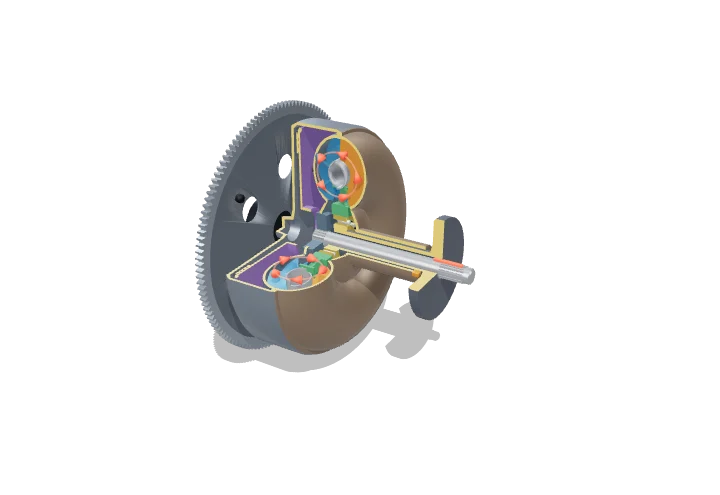 Open the interactive 3D model →
How can an automatic car sit still at a red light in gear with the engine running — without stalling?
An automatic car has no clutch pedal. Instead, the engine spins a fan-like wheel inside a sealed can of oil, and the swirling oil pushes on a second fan-like wheel that drives the gearbox. When the car is held by the brakes the oil just churns, and when you let go it pushes the car away smoothly — even more strongly than the engine alone at first.
A torque converter is a hydrodynamic machine that connects the engine to an automatic gearbox through circulating transmission fluid, so the car can stand still in gear and pull away smoothly. Because a third, fixed element (the stator) redirects the fluid, it also multiplies torque by about 2 : 1 at stall, falling to 1 : 1 at the coupling point, where a lock-up clutch can then remove the remaining slip.
Key facts
- Elements
- impeller (pump), turbine, stator — plus lock-up clutch
- Stall torque ratio
- ≈ 1.8–2.5 : 1 (passenger cars ≈ 2)
- Coupling point
- speed ratio ≈ 0.85–0.9
- Stall speed
- ≈ 1,800–2,800 rpm for typical car converters
- Peak efficiency
- ≈ 85–90 % (converter range); ≈ 97 % as a coupling
- Diameter
- ≈ 230–300 mm for cars
Parts you can explore (10)
- Impeller
- Turbine
- Stator
- One-way clutch
- Stator support
- Turbine shaft
- Front cover
- Lock-up clutch
- Flexplate
- ATF flow
In the 3D model
Rotate and take apart the model, follow a guided tour of what each part does and why it’s needed, change it with a live slider, and test yourself with a short quiz. Free, no sign-up.
OpenArc Models’ models are simplified teaching schematics. Terms · Privacy