Earth & space
Tornado
Earth science · Severe weather
 Open the interactive 3D model →
How does a thunderstorm start spinning — and squeeze that spin into winds of 300 mph?
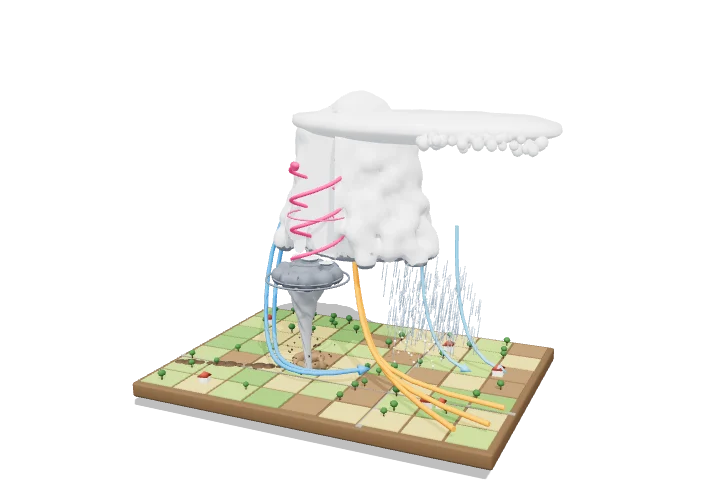
Some thunderstorms, called supercells, have a rising column of air that slowly rotates. Winds that change direction and speed with height give the air a gentle spin, and the storm’s strong updraft tips that spin upright. Under the right conditions, part of it tightens into a narrow, violently spinning tornado that reaches the ground.
A tornado is a violently rotating column of air extending from a thunderstorm to the ground, and the strongest ones form beneath supercells — thunderstorms with a deep, persistently rotating updraft called a mesocyclone. Rotation originates in vertical wind shear, is tilted upright and stretched by the updraft, and is concentrated near the ground where the rear-flank downdraft wraps around the circulation.
Key facts
- Typical tornado width
- ≈ 50–500 m (record ≈ 4.2 km, El Reno 2013)
- Peak winds
- up to ≈ 135 m/s (≈ 480 km/h) measured by Doppler radar
- Mesocyclone diameter
- ≈ 3–10 km
- Tornadoes per year (USA)
- ≈ 1000–1300
- Typical forward speed
- ≈ 10–20 m/s (35–70 km/h)
- Pressure drop in the core
- up to ≈ 100 hPa
Parts you can explore (10)
- Ground and farmland
- Updraft tower
- Anvil
- Mesocyclone
- Wall cloud
- Tornado funnel
- Debris cloud
- Warm moist inflow
- Rear-flank downdraft
- Forward-flank downdraft
In the 3D model
Rotate and take apart the model, follow a guided tour of what each part does and why it’s needed, change it with a live slider, and test yourself with a short quiz. Free, no sign-up.
OpenArc Models’ models are simplified teaching schematics. Terms · Privacy