Human body
Tooth (molar)
Anatomy · Digestive system · Dental
 Open the interactive 3D model →
Enamel is the hardest thing in your body, so how can a sweet drink make a hole in it?
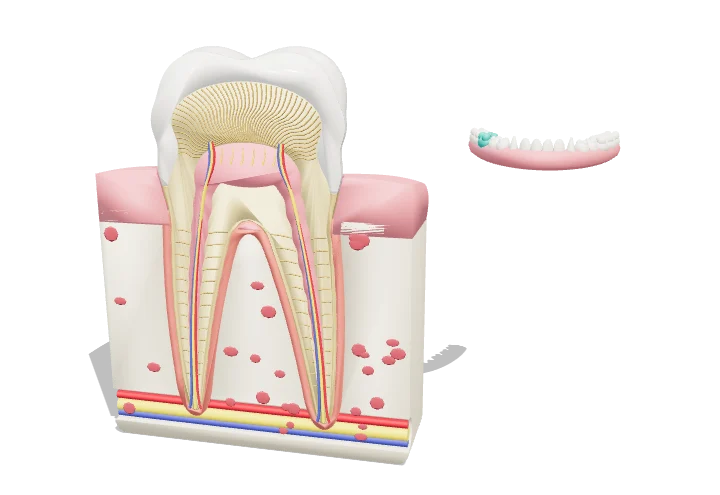
A tooth has a rock-hard outer cap of enamel, a thicker layer of dentin underneath and a soft living centre called the pulp, with nerves and blood vessels. Bacteria on your teeth turn sugar into acid, and the acid slowly dissolves the enamel. If nothing stops it, the decay works inward until it reaches the nerve — and that is when it hurts.
A tooth is a layered organ: hard enamel and dentin surround a living pulp, and the root is slung in a bony socket by the periodontal ligament. Dental caries is a bacterial, acid-driven loss of mineral that progresses from reversible enamel demineralisation to pulp infection and a periapical abscess.
Key facts
- Permanent teeth
- 32 (per quadrant: 2 incisors, 1 canine, 2 premolars, 3 molars)
- Enamel mineral content
- ≈ 96% by mass (hydroxyapatite)
- Dentin mineral content
- ≈ 70% by mass
- Critical pH for enamel
- ≈ 5.5
- Periodontal ligament width
- ≈ 0.15–0.4 mm
- Lower first molar
- crown ≈ 11 mm mesiodistal; roots ≈ 13–14 mm
Parts you can explore (11)
- Enamel
- Dentin
- Dentinal tubules
- Pulp
- Nerves & vessels
- Cementum
- Periodontal ligament
- Alveolar bone
- Gingiva
- Caries lesion
- Dentition (arch)
In the 3D model
Rotate and take apart the model, follow a guided tour of what each part does and why it’s needed, change it with a live slider, and test yourself with a short quiz. Free, no sign-up.
OpenArc Models’ models are simplified teaching schematics. Terms · Privacy