Human body
Tongue and taste buds
Anatomy · Special senses
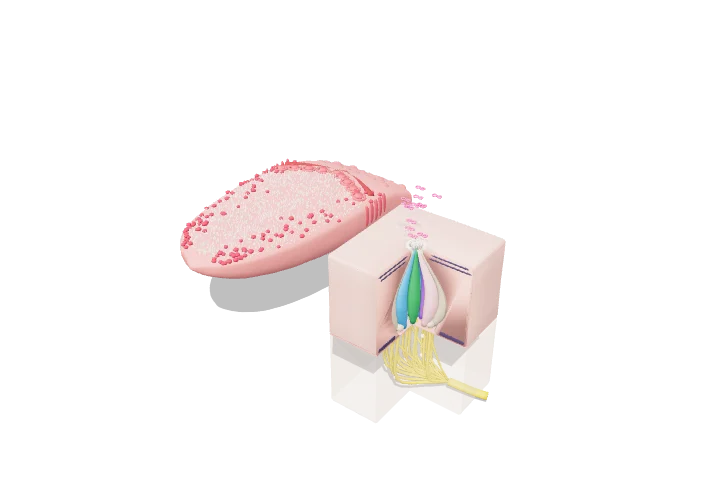 Open the interactive 3D model →
Is there really a "sweet zone" on the tip of your tongue?
Your tongue is covered in little bumps called papillae, and some of them hold taste buds — tiny clusters of cells that open to the surface through a pore. Inside each bud, different cells detect sweet, umami (savoury), bitter, sour and salty, and every part of the tongue with taste buds can sense all five. The cells send their messages along nerves to the brain.
Taste is detected by a few thousand taste buds on the fungiform, foliate and circumvallate papillae of the tongue, each a bundle of 50–100 specialised epithelial cells opening to the surface through a taste pore. Separate receptor cells detect sweet, umami and bitter through G-protein-coupled receptors and sour and salty through ion channels, and signal to cranial nerves VII, IX and X.
Key facts
- Taste buds (adult)
- ≈ 2,000–5,000, most on the tongue
- Cells per bud
- ≈ 50–100 (up to ~150)
- Taste-bud size
- ≈ 50–70 µm tall, 30–60 µm wide
- Cell lifespan
- ≈ 1–2 weeks on average; replaced from basal cells
- Basic tastes
- 5: sweet, umami, bitter, sour, salty
- Cranial nerves
- VII (anterior two-thirds), IX (posterior third), X (epiglottis and pharynx)
Parts you can explore (15)
- Tongue
- Filiform papillae
- Fungiform papillae
- Foliate papillae
- Circumvallate papillae
- Lingual epithelium
- Supporting and basal cells
- Sweet receptor cells
- Umami receptor cells
- Bitter receptor cells
- Sour-sensing cells
- Salt-sensing cells
- Taste pore and microvilli
- Gustatory nerve fibres
- Tastant molecules
In the 3D model
Rotate and take apart the model, follow a guided tour of what each part does and why it’s needed, change it with a live slider, and test yourself with a short quiz. Free, no sign-up.
Open Tongue and taste buds in 3D →
OpenArc Models’ models are simplified teaching schematics. Terms · Privacy