Fluids & heat
Flush toilet
Fluid mechanics · Siphon
 Open the interactive 3D model →
Why does a toilet suddenly gulp the bowl empty with a gurgle, instead of just overflowing?
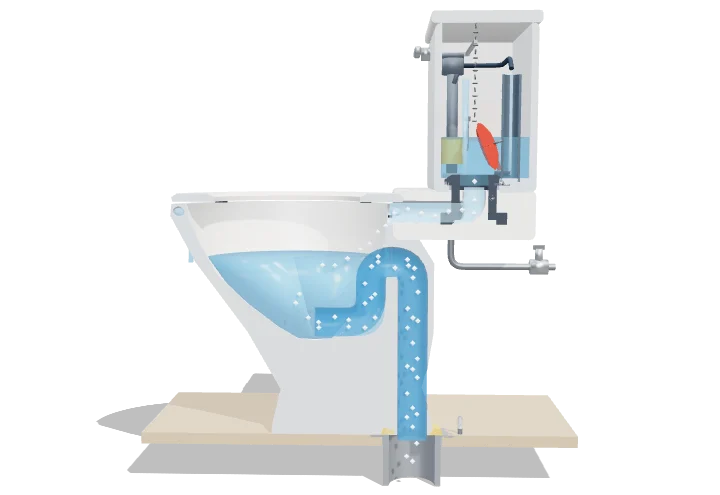
Pressing the handle lets a tank of water rush into the bowl. The water fills a hidden S-shaped pipe behind the bowl completely, and that full pipe works as a siphon, pulling everything out in a few seconds until air gets in with a gurgle. Then a floating valve refills the tank and the bowl, ready for next time.
A siphonic gravity toilet uses a few litres of stored water to raise the bowl level until its S-shaped trapway runs full, at which point the trapway acts as a siphon and empties the bowl rapidly. A float-controlled fill valve then refills the cistern and, through the refill tube, restores the water seal that keeps sewer gas out of the building.
Key facts
- Flush volume (modern)
- 6 L (UK/EU), 4.8 L "high-efficiency" or 6 L/1.6 gal (US); older units 9–13 L
- Trap seal depth
- ≈ 50 mm (2 in) minimum in most plumbing codes
- Trapway bore
- ≈ 45–60 mm; must pass a 38–50 mm ball in standard tests
- Cistern head
- ≈ 0.3–0.6 m of water above the bowl
- Peak siphon flow
- of order 2–3 L/s
- Refill time
- ≈ 30–90 s, set by supply pressure and fill-valve size
Parts you can explore (14)
- Toilet bowl
- Seat
- Rim and jets
- Trapway (siphon)
- Bowl water
- Cistern
- Tank water
- Flush valve and flapper
- Overflow tube
- Fill valve
- Float
- Refill tube
- Flush handle and chain
- Floor and waste outlet
In the 3D model
Rotate and take apart the model, follow a guided tour of what each part does and why it’s needed, change it with a live slider, and test yourself with a short quiz. Free, no sign-up.
OpenArc Models’ models are simplified teaching schematics. Terms · Privacy