Chemistry
Acid–base titration
Analytical chemistry · Volumetric analysis
 Open the interactive 3D model →
How can a few drops of pink dye tell you exactly how much acid is in a flask?
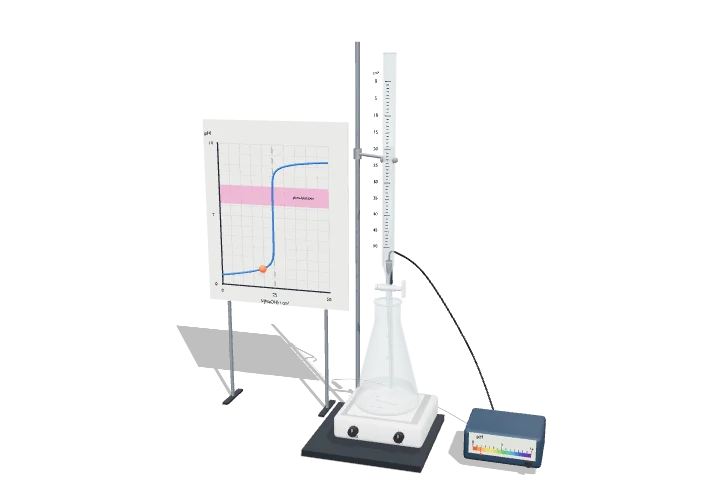
In a titration you add a base, drop by drop, to an acid until the two have exactly cancelled each other out. You know how strong the base is, so the volume you needed tells you how much acid there was. A dye called an indicator turns pink the moment there is a tiny bit of base left over.
In an acid–base titration a solution of accurately known concentration is added from a burette until it has exactly neutralised a measured volume of the unknown. For 0.100 M HCl against 0.100 M NaOH the pH rises slowly, then leaps from about 4 to 10 within a single drop at 25.00 cm³, which an indicator such as phenolphthalein or a pH electrode detects.
Key facts
- Analyte
- 25.0 cm³ of 0.100 mol dm⁻³ HCl
- Titrant
- 0.100 mol dm⁻³ NaOH
- Equivalence volume
- 25.00 cm³
- pH at equivalence (25 °C)
- 7.00
- Phenolphthalein range
- pH ≈ 8.2 (colourless) → 10.0 (pink)
- Burette reading precision
- ± 0.05 cm³
Parts you can explore (13)
- Burette
- Stopcock
- NaOH titrant
- Titrant drops
- Conical flask
- Analyte (HCl + phenolphthalein)
- White tile
- Magnetic stirrer
- Stir bar
- pH probe
- pH meter
- Retort stand and clamp
- Titration curve
In the 3D model
Rotate and take apart the model, follow a guided tour of what each part does and why it’s needed, change it with a live slider, and test yourself with a short quiz. Free, no sign-up.
Open Acid–base titration in 3D →
OpenArc Models’ models are simplified teaching schematics. Terms · Privacy