Power & energy
Tidal stream turbine
Renewable energy · Marine power
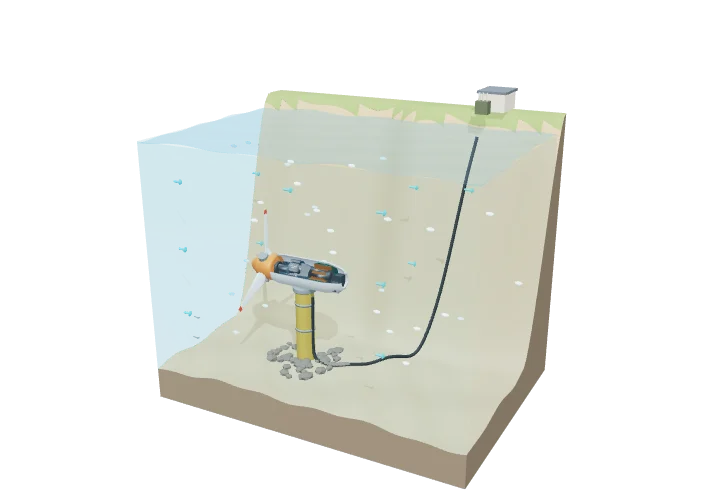 Open the interactive 3D model →
Can the Moon’s pull on the oceans keep the lights on — and why does a tidal turbine need such short blades?
Twice a day the Moon and Sun pull the sea in and out, and in narrow channels the water rushes through like a fast river. A tidal turbine is an underwater windmill on the seabed that this current spins to make electricity. Because water is so much heavier than air, a slow current pushes as hard as a gale.
A tidal stream turbine is an underwater rotor that extracts kinetic energy from tidal currents, which reverse direction roughly every 6.2 hours as the Moon and Sun raise and lower the sea. Because power scales with the cube of current speed and seawater is about 830 times denser than air, an 18 m rotor in a 3 m/s current can deliver about 1.5 MW.
Key facts
- Available power
- P = ½ρAv³Cp
- Example machine
- 18 m rotor, 1.5 MW rated at ≈ 3 m/s
- Seawater density
- ≈ 1025 kg m⁻³
- Semidiurnal tidal period (M₂)
- 12.42 h: two floods and two ebbs a day
- Viable sites
- Peak spring currents above ≈ 2.5 m/s
- Betz limit
- Cp ≤ 16/27 ≈ 0.59; real rotors ≈ 0.35–0.45
Parts you can explore (12)
- Seabed and scour protection
- Monopile tower
- Nacelle
- Main shaft and bearing
- Gearbox
- Generator
- Rotor hub
- Blades
- Export cable
- Onshore substation
- Seawater
- Tidal current
In the 3D model
Rotate and take apart the model, follow a guided tour of what each part does and why it’s needed, change it with a live slider, and test yourself with a short quiz. Free, no sign-up.
Open Tidal stream turbine in 3D →
OpenArc Models’ models are simplified teaching schematics. Terms · Privacy