Human body
Thyroid gland
Anatomy · Endocrine system
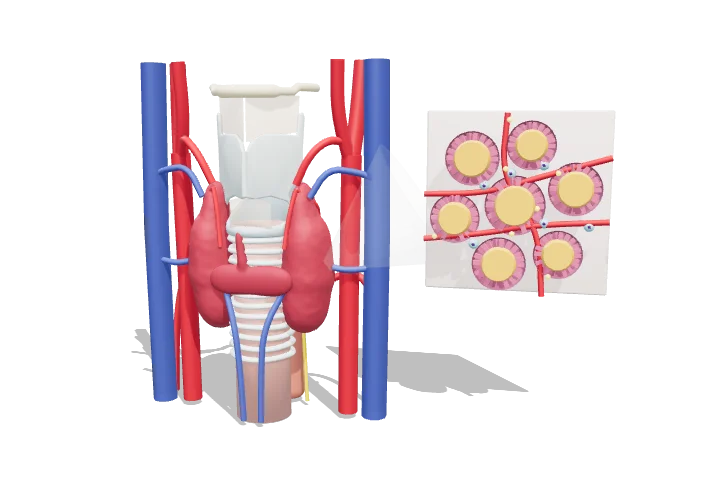 Open the interactive 3D model →
Why does salt in many countries have iodine added to it?
The thyroid is a small, butterfly-shaped gland in the front of your neck. It uses iodine from your food to make hormones that set how fast your body burns energy and help children’s brains and bodies grow. A hormone from the brain, called TSH, tells it when to make more.
The thyroid is an endocrine gland in the front of the neck that stores its hormone precursor, thyroglobulin, as colloid inside follicles and releases thyroxine (T₄) and triiodothyronine (T₃) under the control of pituitary TSH. Thyroid hormones set the basal metabolic rate and are essential for growth and brain development, while the neighbouring parathyroid glands and the gland’s C cells help regulate calcium.
Key facts
- Mass (adult)
- ≈ 15–25 g
- Lobe size
- ≈ 5 × 3 × 2 cm
- Blood flow
- ≈ 4–6 mL/min per gram
- T₄ secretion
- ≈ 80–100 µg/day
- TSH reference range
- ≈ 0.4–4.0 mIU/L (laboratory-dependent)
- Daily iodine need (adult)
- ≈ 150 µg; 250 µg in pregnancy
Parts you can explore (16)
- Thyroid lobes
- Isthmus & pyramidal lobe
- Parathyroid glands
- Thyroid cartilage
- Cricoid cartilage
- Hyoid bone
- Trachea
- Oesophagus
- Superior thyroid arteries
- Inferior thyroid arteries
- Thyroid veins
- Carotid arteries & jugular veins
- Recurrent laryngeal nerves
- Thyroid follicles (inset)
- C cells (inset)
- T₄/T₃ release (inset)
In the 3D model
Rotate and take apart the model, follow a guided tour of what each part does and why it’s needed, change it with a live slider, and test yourself with a short quiz. Free, no sign-up.
OpenArc Models’ models are simplified teaching schematics. Terms · Privacy