Earth & space
Thunderstorm and lightning
Earth science · Atmospheric electricity
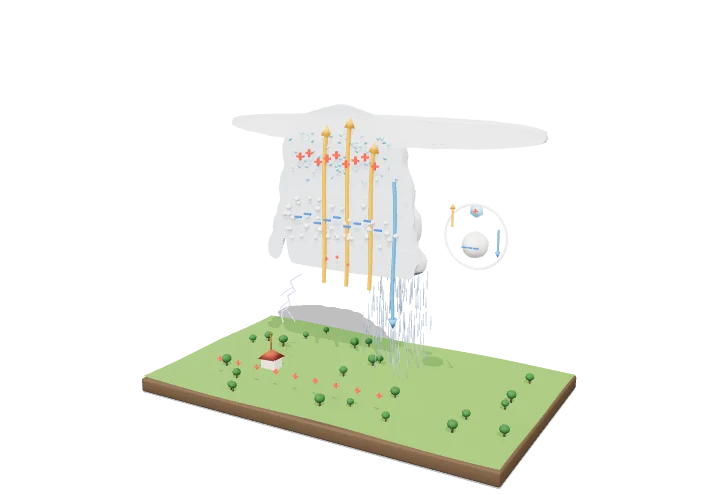 Open the interactive 3D model →
Where does a cloud get enough electricity to make a spark five times hotter than the Sun’s surface?
Inside a tall thunderstorm cloud, strong winds toss tiny ice crystals and soft hail pellets past each other. Each bump moves a tiny bit of electric charge, and over minutes the cloud builds up a huge charge difference. When the air can no longer hold it back, a giant spark — lightning — jumps to the ground, heating the air so fast it explodes into thunder.
Lightning is a giant electrical discharge that neutralises charge separated inside a cumulonimbus cloud, mainly by rebounding collisions between ice crystals and graupel in the presence of supercooled water. A cloud-to-ground flash begins with a stepped leader descending from the cloud, and when it connects with an upward streamer a return stroke heats the channel to about 30 000 K, producing the flash and the thunder.
Key facts
- Global flash rate
- ≈ 45 flashes per second (≈ 1.4 billion per year)
- Peak return-stroke current
- typically ≈ 30 kA (range 5–200 kA)
- Channel temperature
- ≈ 30 000 K
- Charge lowered per flash
- ≈ 5–20 C (typical negative flash)
- Main negative charge level
- ≈ −10 to −20 °C (≈ 6–8 km)
- Share of flashes reaching ground
- ≈ 20–25%; the rest stay in or between clouds
Parts you can explore (11)
- Cumulonimbus cloud
- Anvil
- Updrafts
- Ice crystals
- Graupel
- Charge centres
- Stepped leader
- Return stroke
- Thunder
- Ground and induced charge
- Collision close-up
In the 3D model
Rotate and take apart the model, follow a guided tour of what each part does and why it’s needed, change it with a live slider, and test yourself with a short quiz. Free, no sign-up.
Open Thunderstorm and lightning in 3D →
OpenArc Models’ models are simplified teaching schematics. Terms · Privacy