Electromagnetism & electronics
Tesla coil
Electromagnetism · Resonant transformers
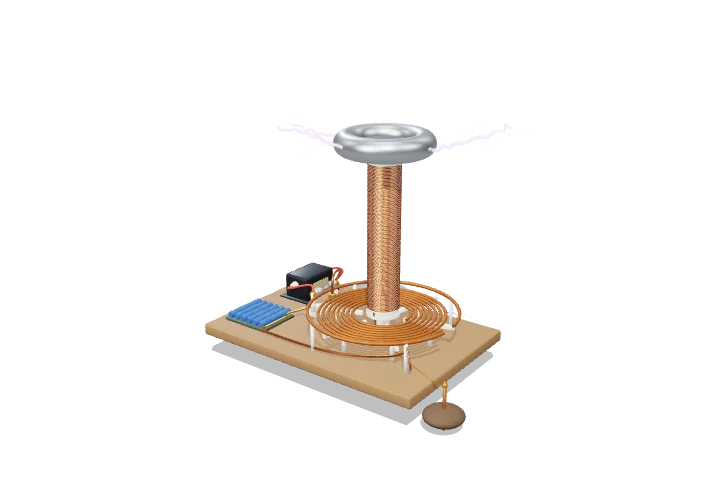 Open the interactive 3D model →
How can a coil of wire throw lightning-like sparks a metre long into the air?
A Tesla coil has two coils that each “ring” electrically at the same rate, like two identical tuning forks. A spark gives the short, thick bottom coil a sudden kick, and because the tall, thin coil rings at exactly the same rate, energy piles up in it with every swing. The voltage at the top climbs to hundreds of thousands of volts — enough to tear the air apart into sparks.
A Tesla coil is an air-cored resonant transformer: a spark gap repeatedly dumps a charged capacitor into a few-turn primary coil, and the loosely coupled, many-turn secondary coil rings up to hundreds of kilovolts. Efficient energy transfer requires both LC circuits to share the same resonant frequency, f = 1/(2π√LC).
Key facts
- Operating frequency
- ≈ 50–500 kHz (this coil ≈ 237 kHz)
- Coupling coefficient
- k ≈ 0.1–0.2 (loosely coupled, air core)
- Transformer supply
- ≈ 15 kV, 60 mA neon-sign transformer
- Secondary turns
- ≈ 800–1200 on a form 4–5× taller than wide
- Top voltage
- Hundreds of kV for a bench-top coil
- Air breakdown field
- ≈ 3 MV/m at sea level
Parts you can explore (11)
- Mains transformer
- Primary capacitor
- Spark gap
- Primary coil
- Secondary coil
- Toroid
- Streamers
- Strike ring
- Primary wiring
- RF ground
- Base platform
In the 3D model
Rotate and take apart the model, follow a guided tour of what each part does and why it’s needed, change it with a live slider, and test yourself with a short quiz. Free, no sign-up.
OpenArc Models’ models are simplified teaching schematics. Terms · Privacy