Plants & animals
Tardigrade
Animals · Ecdysozoa
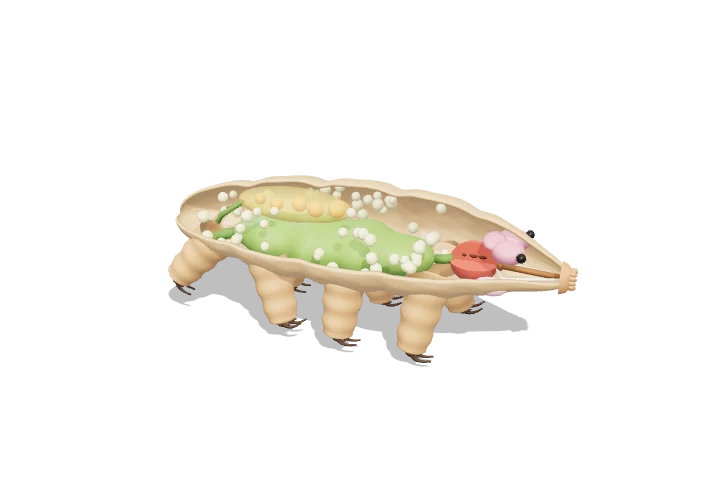 Open the interactive 3D model →
How can a half-millimetre animal dry out completely, then walk away years later when you add water?
A tardigrade, or water bear, is a tiny eight-legged animal that lives in the film of water on moss and lichen. If its home dries up, it pulls in its head and legs and curls into a dry little barrel called a tun. In that state it uses no measurable energy, and it can come back to life within hours of getting wet again.
Tardigrades are microscopic, eight-legged animals with a head and four trunk segments that live in films of water on moss, lichens, soil and sediments. Many can survive complete drying by contracting into a dormant “tun”, a state of anhydrobiosis from which they revive within hours of rehydration.
Key facts
- Body length
- ≈ 0.1–1.5 mm (typically 0.3–0.5 mm)
- Described species
- ≈ 1,400–1,500
- Legs
- 8 unjointed lobopods, each with 4–8 claws or digits
- Water content
- ≈ 85% active; ≈ 1–3% in the tun
- Phylum
- Tardigrada (Panarthropoda, Ecdysozoa)
- Lifespan (active)
- ≈ months to a couple of years, not counting dormancy
Parts you can explore (9)
- Cuticle
- Legs
- Claws
- Head
- Buccal tube and stylets
- Pharynx
- Gut
- Gonad
- Storage cells
In the 3D model
Rotate and take apart the model, follow a guided tour of what each part does and why it’s needed, change it with a live slider, and test yourself with a short quiz. Free, no sign-up.
OpenArc Models’ models are simplified teaching schematics. Terms · Privacy