Mechanisms
Double-wishbone suspension
Vehicle dynamics · Short–long arm suspension
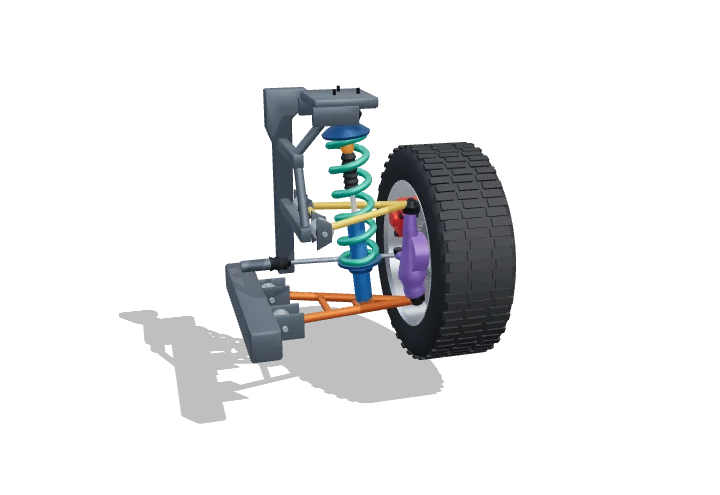 Open the interactive 3D model →
How can a car wheel bounce over a bump while the body above it barely moves?
Each wheel hangs on two A-shaped arms that let it move up and down but not sideways. A coil spring holds up the car, and a damper (shock absorber) stops it bouncing. Together they let the wheel follow the road while the body glides over it.
A double-wishbone suspension locates each wheel with two A-shaped control arms so it can move vertically while its camber and track are tightly controlled. The spring supports the car’s weight and sets the body’s natural frequency, while the damper dissipates energy so oscillations die out quickly — a real-world spring–mass–damper system.
Key facts
- Passenger-car ride frequency
- ≈ 1.0–1.5 Hz (model: 1.2 Hz)
- Wheel-hop frequency
- ≈ 10–15 Hz (unsprung mass on the tyre)
- Damping ratio, passenger cars
- ζ ≈ 0.2–0.4
- Wheel rate from spring rate
- K_w = k_s × MR²
- Model motion ratio
- MR ≈ 0.6 → K_w ≈ 0.36 k_s
- Typical wheel travel
- ≈ ±70–100 mm (road cars)
Parts you can explore (12)
- Chassis mount
- Upper control arm
- Lower control arm
- Ball joints
- Upright
- Hub & wheel bearing
- Brake disc & caliper
- Wheel & tyre
- Coil spring
- Damper
- Bump stop & boot
- Tie rod
In the 3D model
Rotate and take apart the model, follow a guided tour of what each part does and why it’s needed, change it with a live slider, and test yourself with a short quiz. Free, no sign-up.
Open Double-wishbone suspension in 3D →
OpenArc Models’ models are simplified teaching schematics. Terms · Privacy