Astronomy & space
Core-collapse supernova
Astrophysics · Stellar death
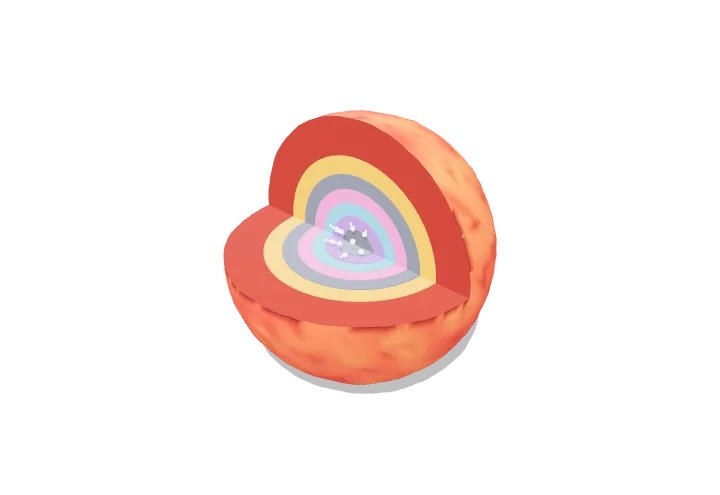 Open the interactive 3D model →
How can a star’s core collapse in less than a second and then blast the rest of the star across space?
A star much heavier than the Sun builds up layers of heavier and heavier elements, like an onion, until its centre is iron. Iron cannot be burned for energy, so the core suddenly collapses into a ball only about 20 km across. The rebound sends a shock wave out through the star and blows it apart, scattering the elements it made into space.
A star of more than about 8 solar masses ends with an iron core that cannot release energy by fusion; when that core exceeds roughly 1.4 solar masses it collapses in under a second to a neutron star. The rebound shock, revived by neutrinos, blows the rest of the star apart as a Type II (or Ib/Ic) supernova and spreads newly made elements into space.
Key facts
- Progenitor mass
- ≳ 8 M☉ at birth
- Iron-core mass at collapse
- ≈ 1.3–1.8 M☉, roughly Earth-sized
- Collapse time
- ≈ 0.2–0.5 s
- Energy released
- ≈ 3 × 10⁴⁶ J (≈ 99 % in neutrinos)
- Ejecta kinetic energy
- ≈ 10⁴⁴ J (“1 foe”), speeds ~10⁴ km/s
- Galactic rate
- ≈ 1–3 per century in the Milky Way
Parts you can explore (11)
- Hydrogen envelope
- Helium shell
- Carbon shell
- Neon shell
- Oxygen shell
- Silicon shell
- Iron core
- Neutron star remnant
- Shock wave
- Expanding ejecta
- Neutrino burst
In the 3D model
Rotate and take apart the model, follow a guided tour of what each part does and why it’s needed, change it with a live slider, and test yourself with a short quiz. Free, no sign-up.
Open Core-collapse supernova in 3D →
OpenArc Models’ models are simplified teaching schematics. Terms · Privacy