Mechanisms
Straight-line linkages
Mechanisms · Path generation
 Open the interactive 3D model →
How do you draw a perfectly straight line using only bars that swing in circles?
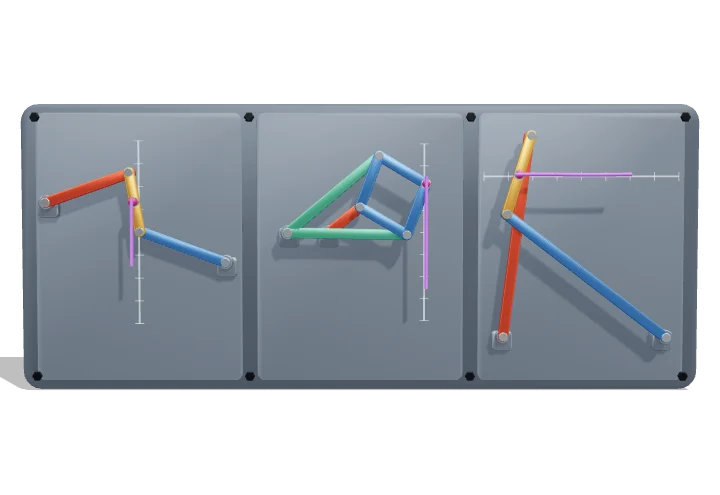
A bar pinned at one end can only swing its other end round in a circle. Yet steam engines needed rods that moved in straight lines, long before smooth sliding guides were easy to make. Clever arrangements of bars cancel out the curves — two of them almost perfectly, and one of them exactly.
Pin-jointed linkages naturally produce circular arcs, yet many machines need a point to move in a straight line. Watt’s and Chebyshev’s linkages approximate a straight line closely over part of their travel, while the Peaucellier–Lipkin linkage uses geometric inversion to generate an exactly straight line with nothing but pins and rigid bars.
Key facts
- Watt’s linkage (patented)
- 1784
- Peaucellier–Lipkin linkage
- 1864 / 1871
- Peaucellier inversion constant
- OP · OQ = l² − s²
- Chebyshev proportions
- ground 4 : rockers 5 : coupler 2
- Model Watt error at ±26° lever swing
- ≈ 1.1 % of stroke
- Peaucellier error at any swing
- 0 (exact)
Parts you can explore (9)
- Watt's linkage
- Peaucellier input crank
- Peaucellier–Lipkin inversor
- Chebyshev linkage
- Fixed pivots
- Tracer points
- Traced paths
- Reference lines
- Base plate
In the 3D model
Rotate and take apart the model, follow a guided tour of what each part does and why it’s needed, change it with a live slider, and test yourself with a short quiz. Free, no sign-up.
Open Straight-line linkages in 3D →
OpenArc Models’ models are simplified teaching schematics. Terms · Privacy