Human body
Stomach
Anatomy · Digestive system
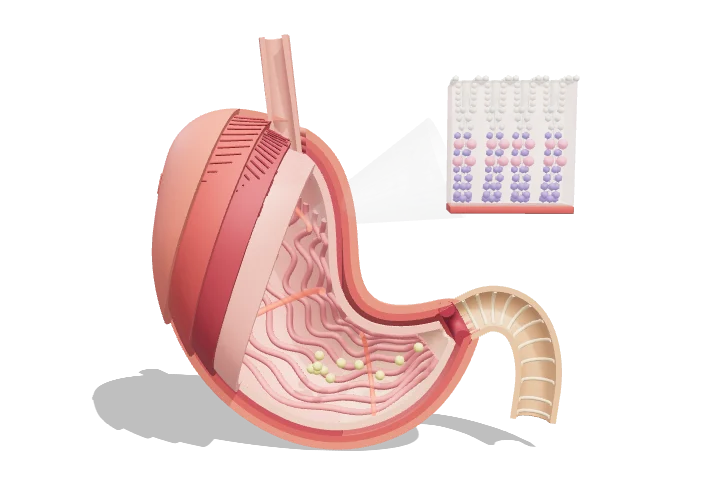 Open the interactive 3D model →
Your stomach is full of acid and protein-cutting enzymes, so why doesn’t it digest itself?
Your stomach is a stretchy, muscular bag that stores a meal and starts breaking it down. Tiny glands in its lining pour out acid and a protein-cutting enzyme, while three layers of muscle squeeze in waves to churn food into a thick soup. A ring of muscle at the bottom lets out only small amounts at a time.
The stomach is a muscular J-shaped reservoir that stores a meal, begins protein digestion with acid and pepsin, and grinds food into chyme. Its three-layered muscularis drives peristaltic waves that churn the contents against a nearly closed pylorus, releasing only small particles into the duodenum.
Key facts
- Capacity
- ≈ 50 mL empty, 1–1.5 L after a meal (up to ~4 L)
- Gastric juice
- ≈ 1.5–2.5 L/day, pH ≈ 1–2 in the lumen
- Slow-wave frequency
- ≈ 3 per minute
- Gastric pits
- ≈ 3.5 million (each leading into 3–7 glands)
- Emptying of a mixed meal
- ≈ 50% in 1–2 h, mostly complete in ~4 h
- Particle size passing pylorus
- ≤ ≈ 1–2 mm
Parts you can explore (15)
- Oesophagus
- Lower oesophageal sphincter
- Fundus
- Body
- Antrum
- Pylorus & pyloric sphincter
- Duodenum
- Rugae
- Longitudinal muscle layer
- Circular muscle layer
- Oblique muscle layer
- Gastric pits & glands (inset)
- Parietal cells
- Chief cells
- Peristalsis & chyme
In the 3D model
Rotate and take apart the model, follow a guided tour of what each part does and why it’s needed, change it with a live slider, and test yourself with a short quiz. Free, no sign-up.
OpenArc Models’ models are simplified teaching schematics. Terms · Privacy