Power & energy
Stirling engine
Heat engines · External combustion
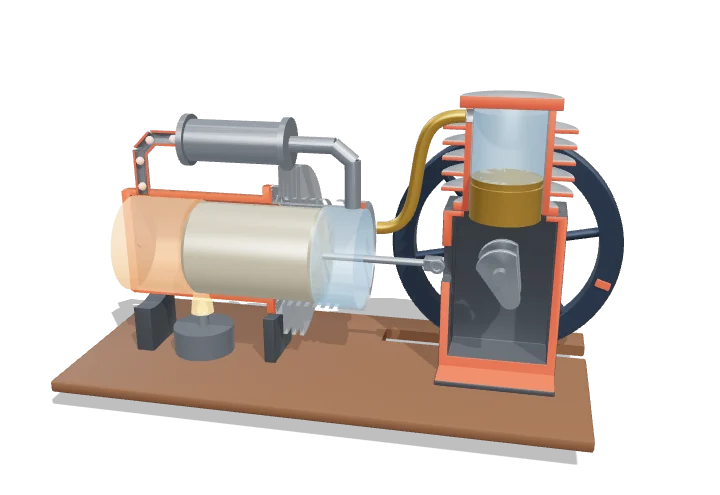 Open the interactive 3D model →
How can an engine run on a candle, sunlight or even the warmth of your hand, without any explosions inside?
A Stirling engine keeps the same gas sealed inside for ever and simply heats one end and cools the other. Gas expands when it is hot and shrinks when it is cold, so shuffling it back and forth between the two ends makes its pressure rise and fall. That pressure pushes a piston, which turns a wheel.
A Stirling engine is a closed-cycle heat engine: a fixed charge of gas is shuttled by a displacer between a hot space and a cold space, so its pressure rises and falls, and a power piston turns that pressure swing into work. With an ideal regenerator storing and returning heat between the two halves of the cycle, its efficiency equals the Carnot limit 1 − T_c/T_h.
Key facts
- Cycle (ideal)
- Two isotherms + two constant-volume regenerative steps
- Ideal efficiency
- η = 1 − T_c/T_h (Carnot), with perfect regeneration
- Phase angle
- Displacer leads power piston by ≈ 90°
- Working gas
- Air (demonstrators); helium or hydrogen at 5–20 MPa (high-performance)
- Heat source
- External: flame, sunlight, waste heat, radioisotope decay
- Beale number
- B ≈ 0.11–0.15 for well-developed engines
Parts you can explore (12)
- Hot cylinder
- Cold cylinder
- Regenerator
- Displacer
- Power cylinder
- Power piston
- Connecting rods
- Crankshaft
- Flywheel
- Heat source
- Base frame
- Working gas
In the 3D model
Rotate and take apart the model, follow a guided tour of what each part does and why it’s needed, change it with a live slider, and test yourself with a short quiz. Free, no sign-up.
OpenArc Models’ models are simplified teaching schematics. Terms · Privacy